

Honestly, I never thought I would be the one to leave. I was the “safe choice” kind of student. Decent grades, commerce background, family expecting me to sit for CA or land a government job. But somewhere in my third year of BCom, something shifted. I started reading about CFA candidates working in Singapore, FRM holders at risk desks in London, CPAs building careers in Canada. And I thought… why not me?
Nobody in my circle had done it. That was the scariest part. But also, weirdly, the most exciting part.
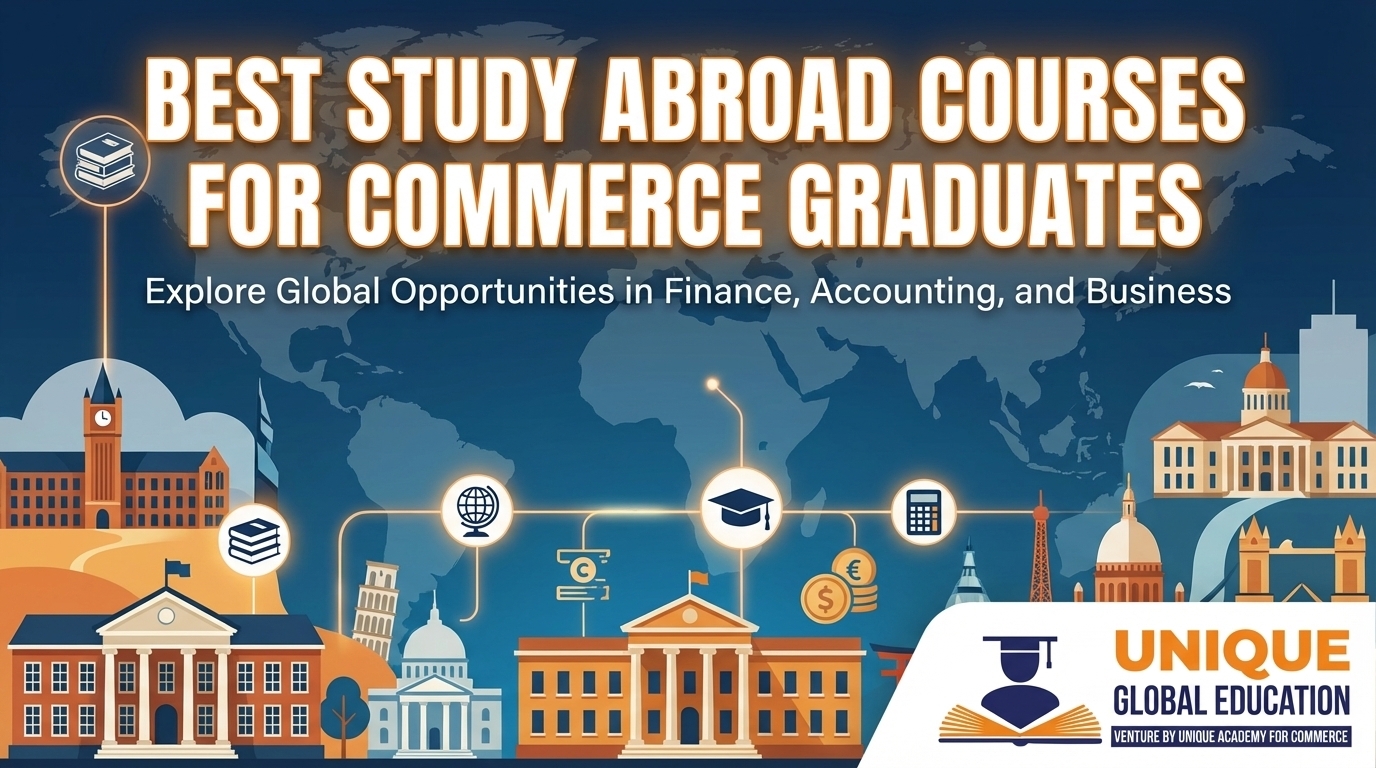
If you are a commerce graduate reading this and feeling that same pull, I want to give you something real. Not a brochure. Not a ranked list someone copy-pasted. Just honest information about the certifications that actually travel well, open real doors, and are worth your money and your years.
Table of Contents
The Certifications Worth Crossing an Ocean For
CFA (Chartered Financial Analyst)
If capital markets, portfolio management, or equity research is where your heart is, nothing compares to CFA. Offered by the US-based CFA Institute, it is recognised in every serious financial hub on earth. London, Singapore, New York, Hong Kong, Dubai.
Three levels, genuinely tough pass rates, and yes it will consume your evenings for a couple of years. But the credibility it gives you in investment finance is unmatched. People with CFA after their name get taken seriously in rooms where degrees alone no longer impress.
Get More Details CFA Classes Online and Face To Face Batches
US CMA (Certified Management Accountant)
This one is criminally underrated in India. The US CMA from the Institute of Management Accountants focuses on financial planning, cost management, performance analysis, and strategic decision making inside corporations.
It is not about auditing or tax. It is about being the finance brain inside a business. Strong recognition in the USA, UAE, Singapore, and Canada. Two parts, a manageable timeline, and the salary jump it brings in multinational companies is very real.
Get Details for US CMA Online & Face to Face Batches
CPA (Certified Public Accountant)
Think of CPA as the American version of CA, except it opens doors across the USA and with US-based multinationals globally. If you want to practice public accounting in America or work with Big Four firms there, CPA is not optional, it is the entry ticket.
Many BCom and MCom graduates find their Indian academic credits partially satisfy the eligibility hours. States like Montana and New Hampshire are popular among international candidates for relatively flexible rules.
FRM (Financial Risk Manager)

Offered by GARP, the Global Association of Risk Professionals, FRM is the definitive credential if risk management excites you. Banks, hedge funds, insurance companies, and regulatory bodies specifically look for FRM certified professionals.
Two parts, deeply quantitative, but commerce graduates with a solid stats and finance background handle it better than they expect. Best pursued alongside a master’s program or early in a finance career abroad.
Get More Details Of FRM Coaching Classes
ACCA (Association of Chartered Certified Accountants)
If UK or Europe is where you are headed, ACCA might be the single most useful qualification you can hold. Recognised in over 180 countries, it gives you a globally portable accounting credential that employers in London, Dubai, Singapore, and Toronto genuinely respect.
Many BCom graduates receive exemptions for several papers based on their undergraduate subjects, which shortens the journey considerably. Flexible, affordable, and truly global.
Get More Details Face to Face ACCA Classes in Pune & ACCA Online Classes
CAIA (Chartered Alternative Investment Analyst)
Lesser known but quietly powerful. CAIA is your credential if private equity, hedge funds, or venture capital is the goal. Two levels, more manageable than CFA, and the niche positioning actually works in your favour because fewer people hold it. Strong recognition in New York, London, Hong Kong, and Singapore.
CFP (Certified Financial Planner)
If personal finance, wealth advisory, and retirement planning appeal to you more than corporate roles, CFP is your path. The CFP Board is US-based but the credential is recognised across 25 plus countries. Excellent demand in Canada, Australia, Singapore, and the UK where financial planning is a serious regulated profession, not just a side conversation.
How to Actually Choose
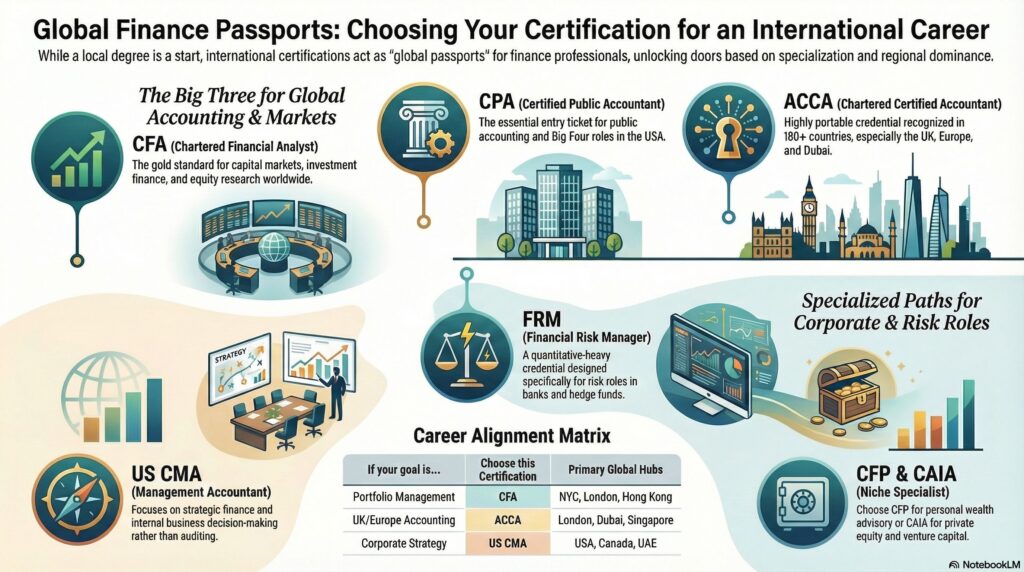
Please do not try to collect all of them. I have seen people spend years chasing certifications and end up more confused about their career than when they started. Pick based on three things. Where do you want to work? What kind of role genuinely excites you? And what are you willing to sacrifice for two to three years to get there?
If markets and investing light you up, go CFA. If you want to be the strategic finance person inside a growing company, go US CMA.
If USA-based public accounting is the dream, go CPA. If risk is your world, go FRM. If UK and Europe are calling, start with ACCA. That logic alone will save you enormous time and money.
And yes, the costs are real. These are dollar-denominated exams and fees stack up across attempts. But employer reimbursement programs exist for CFA and FRM especially, and many universities abroad offer partial scholarships for students pursuing these alongside a master’s degree. Research before you pay out of pocket.
I will tell you something nobody told me. Sitting for a CFA Level 1 exam alone in a foreign city after months of studying in a small apartment is one of the most character-defining experiences a young person can go through. You come out the other side not just with a result but with a different relationship to your own capability. That part is not on any brochure.
Frequently Asked Questions
Stop asking everyone else and ask yourself one honest question. Do you get excited watching markets and investments? Go CFA. Do you love understanding how a business runs from the inside? Go US CMA. That gut answer is your direction.
More people are eligible than they think. Many states allow international candidates if your academic credits meet their requirements. BCom and MCom degrees from India often partially qualify. Check your own transcripts before ruling it out.
Most people finish both parts within one to two years. It is hard, especially the quantitative sections. But commerce graduates who study consistently, six to eight months per part, get through it more often than not. Respect the process and it is very doable.
CA is brilliant inside India. But if going abroad is genuinely your plan, ACCA travels in a way CA simply does not. Recognised in over 180 countries, respected in London, Dubai, Singapore, and Toronto. For that specific goal, ACCA is the smarter choice.
Yes, and not a small one. In Dubai, Singapore, and London, CFA, CPA, and FRM holders enter at mid-level roles with sometimes 40 to 60 percent higher starting pay compared to uncertified peers. The return over five years is not even close.
People do it more than you think. Both are self-study with no fixed classes. Start early in your program, stay consistent, and it is genuinely manageable.
ACCA opens the most doors broadly across UAE, Saudi Arabia, and Qatar. US CMA is strong inside multinationals. CFA carries weight specifically in Dubai’s banking sector. Start with ACCA, add US CMA later. That combination in the Gulf is quietly powerful.