


Every CFA Level 1 candidate eventually asks the same question: “I have four months, which topics do I actually need to nail?” It’s a fair question, because CFA Level 1 Topic Weightage plays a major role in deciding where your study time should go.
The curriculum is broad, and studying every topic with the same intensity is not always the smartest approach. The best way to plan is to start with the official topic weights published by CFA Institute and then understand how those subjects should be prioritised during preparation and revision.
Table of Contents
What the exam is actually testing
CFA Level 1 is 180 multiple-choice questions, split into two sessions of 90 questions each, 135 minutes per session, fully computer-based. There’s no negative marking, so an unanswered question is a guaranteed zero, while a guess at least has a shot. Ten topic areas make up the full syllabus, and each one carries an official weight range published by CFA Institute, unchanged for the 2026 cycle from 2025.
CFA Level 1 Topic Weightage Across All 10 Topics
Session 1, the morning session, covers Ethical and Professional Standards at 15 to 20%, Quantitative Methods at 6 to 9%, Economics at 6 to 9%, Financial Statement Analysis at 11 to 14%, and Corporate Issuers at 6 to 9%.
| Session 1 (Morning) | Exam Weight (2026) |
| Ethical and Professional Standards | 15–20% |
| Quantitative Methods | 6–9% |
| Economics | 6–9% |
| Financial Statement Analysis | 11–14% |
| Corporate Issuers | 6–9% |
Session 2, the afternoon session, covers Equity Investments at 11 to 14%, Fixed Income at 11 to 14%, Derivatives at 5 to 8%, Alternative Investments at 7 to 10%, and Portfolio Management at 8 to 12%.
| Session 2 (Afternoon) | Exam Weight (2026) |
| Equity Investments | 11–14% |
| Fixed Income | 11–14% |
| Derivatives | 5–8% |
| Alternative Investments | 7–10% |
| Portfolio Management | 8–12% |
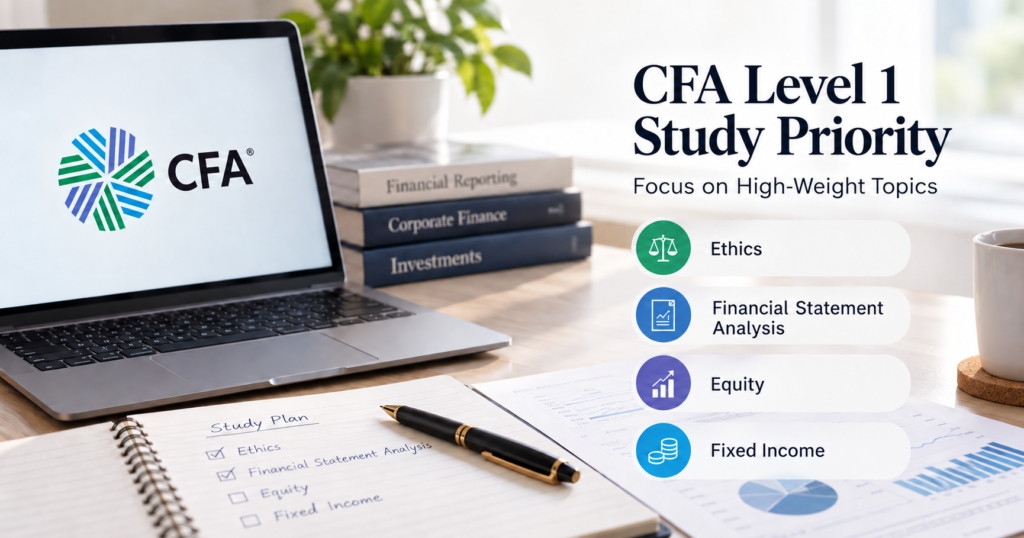
Add up the midpoints and you’ll notice something quickly. Four topics, Ethics, Financial Statement Analysis, Equity Investments, and Fixed Income, together account for roughly half the exam. That’s not a coincidence, and it should shape how you plan your months, not just your final revision week.
Visit Unique Global Education for more CFA Related Update
Why Ethics Deserves More Attention in CFA Level 1
CFA Level 1 Topic Weightage makes Ethics impossible to ignore, as it carries 15 to 20%, the single heaviest topic on the exam, and yet it’s the one candidate most consistently push to the end of their schedule, treating it as something to skim before the exam rather than something to build over months.
That’s backwards. The Code of Ethics and Standards of Professional Conduct reward pattern recognition built through repetition, not last-minute memorisation, and CFA Institute itself has said ethics can function as a tiebreaker for candidates sitting near the pass line. Keep this topic running in parallel with everything else from week one, not bolted on at the end.
Financial Statement Analysis is the technical backbone
FSA sits at 11 to 14% and is where most candidates feel the real academic weight of the program for the first time. It covers the income statement, balance sheet, cash flow statement, and how they connect, along with the accounting adjustments that trip people up repeatedly.
Everything here defaults to IFRS unless a question specifies otherwise, and that single detail catches out more candidates than it should. If your accounting background is weak, this is the topic to start early and revisit often, because it also underpins parts of Corporate Issuers and Equity later in the syllabus.
Equity and Fixed Income: Two High-Weight CFA Level 1 Topics
Both sit at 11 to 14%, and both reward conceptual clarity over memorised formulas. Equity Investments covers market organisation, equity valuation, and industry analysis. Fixed Income covers bond pricing, yield measures, and the mechanics of interest rate risk.
Together with Ethics and FSA, these four topics are where your study hours should be heaviest, simply because they’re where the question count is heaviest too.
Quant, Economics, and Corporate Issuers are mid-weight but not optional
Each of these sits at 6 to 9%, individually smaller than the big four, but collectively still close to a quarter of the exam. Quantitative Methods matters beyond its own weight because it builds the statistical and time-value-of-money tools used throughout the rest of the curriculum, including in later levels.
Economics covers supply and demand, the business cycle, and international trade, and tends to reward candidates who can reason through a scenario rather than recall a formula. Corporate Issuers, the topic that replaced what used to be called Corporate Finance, covers capital structure, governance, and business models. None of these are safe to deprioritise entirely, even at a smaller weight.
Derivatives and Alternative Investments round out the syllabus
Derivatives, at 5 to 8%, is the smallest weight on the exam and also one candidate tend to either love or actively avoid, depending on their comfort with forwards, futures, options, and swaps at an introductory level.
Alternative Investments, at 7 to 10%, has grown in relevance over recent cycles and now covers private equity, real estate, hedge funds, and commodities, including fee structures and the trade-offs of illiquid assets.
Portfolio Management ties the whole syllabus together
At 8 to 12%, Portfolio Management is deliberately placed near the end of most study sequences because it pulls together concepts from nearly every other topic, risk and return, diversification, asset allocation. Treat it as a synthesis topic rather than an isolated one, and it becomes considerably easier to absorb.
A sensible way to sequence your study
There’s no single correct order, but a pattern that works for most candidates is to start with Quantitative Methods to build foundational tools, run Ethics continuously throughout rather than as a block, front-load Financial Statement Analysis and Corporate Issuers together since they connect closely, follow with Equity and Fixed Income once the accounting foundation is solid, then close with Derivatives, Alternative Investments, and Portfolio Management as the final, more integrative stretch.
Successful candidates report studying over 300 hours per level on average, and weighting your time roughly in line with these exam percentages, rather than evenly across all ten topics, is what separates an efficient plan from a scattered one.
Frequently asked questions
No. Weight your hours toward Ethics, Financial Statement Analysis, Equity, and Fixed Income first, since together they’re close to half the exam, and let the smaller-weighted topics like Derivatives get proportionally less time without being skipped entirely.
Because at 15 to 20%, it’s actually the single largest topic on the exam, and CFA Institute has indicated it can act as a differentiator for candidates near the pass boundary. It rewards consistent exposure over months, not a last-week cram.
Worth taking seriously, since it’s 11 to 14% and also feeds into other topics later in the curriculum. Start it early rather than saving it, and lean on IFRS as your default framework unless a question states otherwise.
Not entirely, since skipping it outright means giving up guaranteed marks on a fixed portion of the exam. It’s reasonable to give it less time than the bigger topics, but not to drop it completely.
CFA Institute reviews and can adjust weights periodically through its practice analysis process, and for the 2026 cycle they’re unchanged from 2025. Still, always confirm the current weights on CFA Institute’s own site before finalising your study plan, since blog figures can lag an official update.