




Getting a CFA charter while holding down a full-time job is one of the most common goals I run into, and also one of the most mismanaged. People either burn out chasing an unrealistic schedule copied from some YouTube topper, or they drag preparation across a year with no real structure and end up cramming the last six weeks like it’s a college exam.
Table of Contents
CFA Level 1 Study Plan For Corporate Workers
Having guided a fair number of working professionals through Level 1, and having sat through the grind myself while managing a full-time role, I can tell you the difference between passing comfortably and barely scraping through usually comes down to how the study plan is built around your actual life, not some ideal version of it.
Start with an honest hours audit, not a fixed number
Every prep provider throws around the same figure, 300 plus hours for Level 1. That number is not wrong, but it is useless on its own because it assumes uniform learning speed, which nobody has. If you are coming from a commerce or finance background, quant and financial statement analysis will move faster for you. If you are from engineering or a completely unrelated field, ethics and quant might eat up more time than you expect.
Before building a calendar, sit down for a week and just track how many focused hours you can genuinely give on a weekday versus a weekend. Not the hours you wish you had, the hours you actually have after work calls, commute, and the ordinary chaos of adult life. This number becomes your real planning baseline, and for most working professionals I have seen, it lands somewhere between ten and fifteen hours a week.
Give yourself four to six months, not less
I know some people manage Level 1 in ten weeks, and social media loves showcasing those stories. What it does not show is the burnout, the missed sleep, and in a lot of cases, a retake because the depth just was not there.
For someone working full time, a four-to-six-month runway is realistic and sustainable. It gives you room for a bad week at work, a family emergency, or simply a Monday where you have nothing left in the tank after ten hours in office. Compressing this into eight or ten weeks only works if your job has unusually low demands right now, and even then, it is a stressful bet.
Sequence the topics by weight, not by curiosity
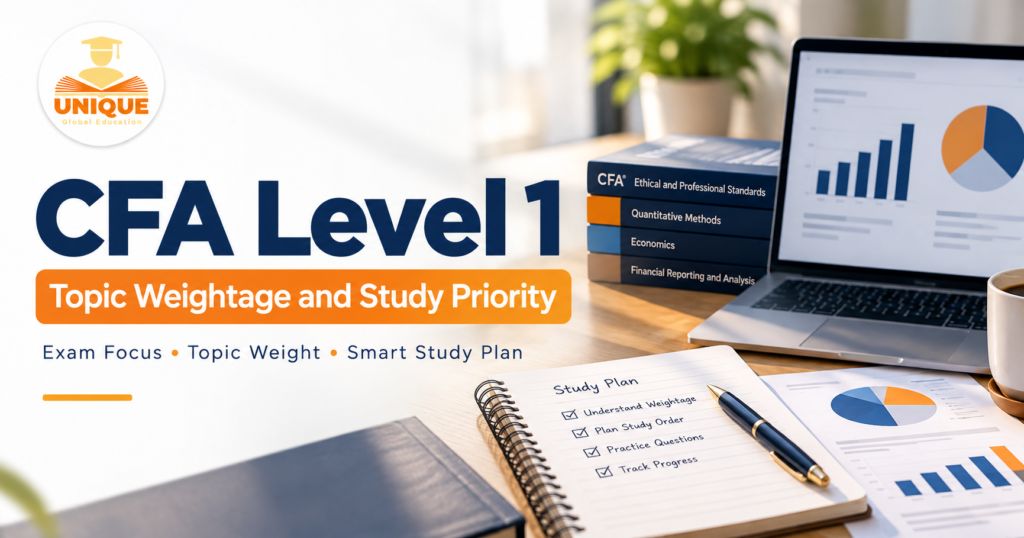
The 2026 curriculum has not changed from 2025, all ninety-three learning modules remain the same, and topic weights are identical too. That stability actually works in your favour because there is no ambiguity about where your effort should go. Ethical and Professional Standards carries the highest weight at fifteen to twenty percent, and it is also the topic people underestimate the most because it feels like common sense until you meet the actual exam questions, which are far more nuanced than they look.
Financial Statement Analysis, Equity, and Fixed Income each sit around eleven to fourteen percent and deserve proportionate time. My advice is always to start with Quant and FSA early since they build the foundation for later topics, keep Ethics running throughout the entire plan instead of treating it as a one-week sprint, and leave the lighter weighted topics like Alternative Investments for later in your schedule.
Build a weekly rhythm you can actually sustain
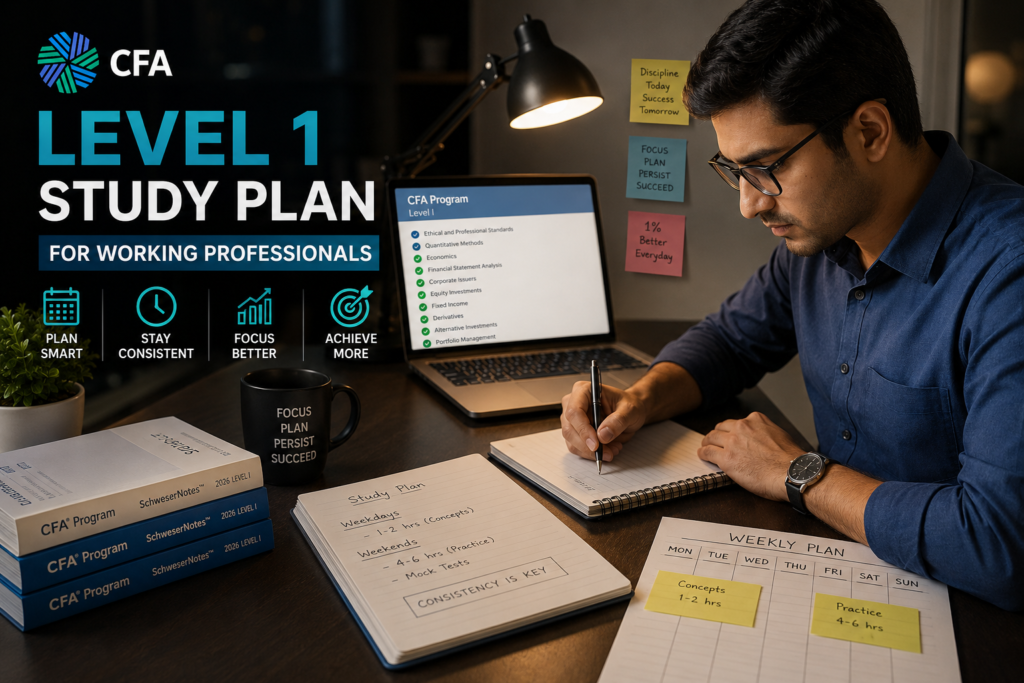
The plan that works best for most working professionals looks something like this. Weekday mornings or late evenings for reading and concept building, since that is when focus is highest without distraction, and weekends reserved for practice questions and revision, since that is when you have longer uninterrupted blocks.
Do not try to learn new concepts on a tired Friday night after work, that is where retention drops the most. Use that slot instead for lighter review or flashcards. I have had clients who protect one hour every single day rather than trying to do four hours on Sunday alone, and consistency like that beats sporadic long sessions almost every time.
Practice questions are not optional, they are the plan
A lot of working professionals treat question banks as something to start once the reading is done. That is backwards. Start doing practice questions from the very first week on whatever topic you have just covered.
CFA Level 1 tests application far more than memory, and you only discover the gaps in your understanding when you attempt questions, not when you re-read notes for the third time. In the last six to eight weeks before the exam, shift almost entirely to mocks and question banks, and treat every full-length mock like the real exam, same duration, same breaks, same pressure.
This is also where you build the stamina to sit through the exam without your concentration collapsing halfway.
Get More Details CFA Level 1 study plan and Classes Online and Face To Face Batches
Protect your recovery time
This gets ignored constantly. If you are working a demanding job and studying on top of it, skipping sleep or cutting out every form of rest to squeeze in extra hours usually backfires within a month. Retention drops, motivation drops, and the risk of quietly giving up on the plan goes up.
Build in one genuinely off day every week where you do not touch the material at all. It is not wasted time; it is what keeps you consistent for the following five months instead of burning out in month two.
FAQs
It is, but you’ll need to stretch your timeline rather than compress your effort. Eight hours a week over seven to eight months adds up to enough hours if you’re consistent and not wasting time on passive reading. What I’d actually worry about is whether eight hours is sustainable for that long, so build in checkpoints every month to see if you’re on track or if you need to either free up more time or push your exam window.
I get asked this a lot, and my honest answer is almost always no. Full time studying sounds efficient, but most people I’ve seen do this end up with too much time and no structure, which is worse than too little time with a tight plan. Unless your job situation is genuinely unmanageable alongside studying, keep working and build the plan around it.
Track your practice question accuracy, not how confident you feel while reading. If you’re consistently scoring above seventy percent on a topic’s question sets, move on even if it doesn’t feel fully polished. If a topic like FSA or Fixed Income is still giving you sub fifty percent after a full pass, that’s where extra hours actually need to go, not into topics you already feel comfortable with.
Yes, and this is actually good news for you. Level 1 curriculum for 2026 is unchanged from 2025, same modules, same weights. If you already have last year’s material or know someone who does, you can use it without worrying about missing updates.
Front loading motivation and back loading discipline. People start strong in month one, study every single day, and then life happens, a heavy work week or two, and the plan quietly falls apart because there was no buffer built in. A realistic plan assumes some weeks will be bad and still gets you to the finish line, that’s the difference between a plan that survives real life and one that only works on paper.






CFA Level 1 students, keep pushing! 📚🔥 Stay consistent, trust the process, and remember—every study session is one step closer to your goal. 💯📈 #CFA #CFALevel1 #FutureCFA