


So, you’ve just finished your graduation and someone, maybe a senior, maybe a LinkedIn post, mentioned CFA. You looked it up, saw words like “chartered financial analyst,” “globally recognised,” and “Wall Street,” and now you’re sitting here wondering: can I actually do this right after college?
The answer is yes. Many students explore CFA after graduation to build careers in investment management, financial analysis, and global finance. But before starting, it is important to understand the eligibility requirements, exam structure, and complete CFA journey.
Table of Contents
First, What Exactly Is CFA?
CFA stands for Chartered Financial Analyst. It’s a credential offered through the CFA Program, run by the CFA Institute, a US-based organisation. The program has three levels, Level 1, Level 2, and Level 3. You clear all three, meet the work experience requirement, and you earn the CFA charter, becoming a CFA charterholder.
The reason people take it seriously, especially in investment banking, portfolio management, equity research, and asset management, is because the curriculum is genuinely tough. It covers financial reporting and analysis, fixed income, derivatives, equity, economics, ethics, and portfolio management. It’s not a shortcut credential. It takes real effort and real time.
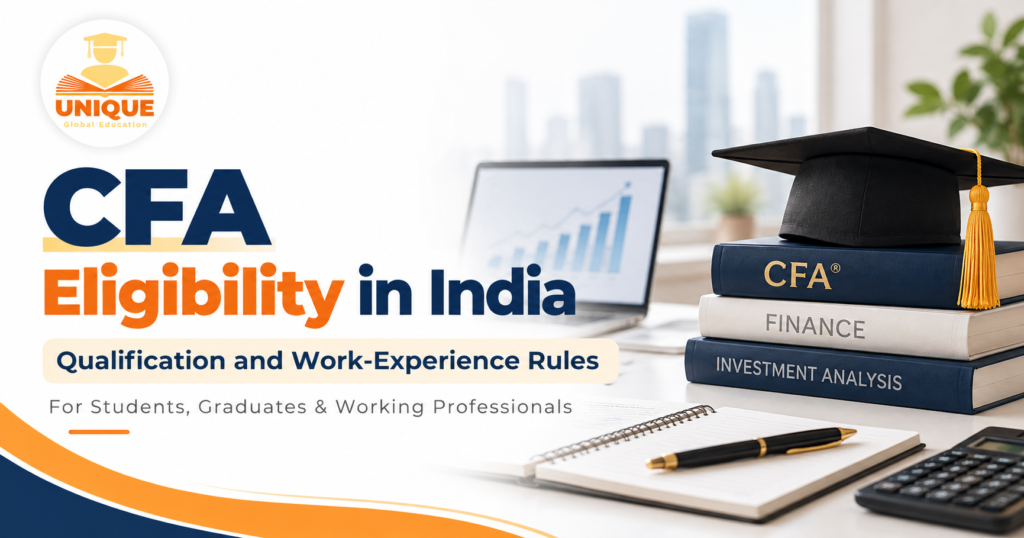
CFA Eligibility After Graduation: Who Can Apply?
Here’s where a lot of freshers get confused. You don’t need to be sitting on a finished degree to start. You’re eligible to register for CFA Level 1 as long as your exam window falls within 23 months of your expected graduation date. In practice, this means most final-year students and recent graduates comfortably fall within that eligibility window.
So, if you’re finishing your BCom, BBA, BSc, or any other undergraduate degree, you can plan for Level 1 without waiting around. The degree itself only gets checked much later, when you apply for the charter. Registering and sitting for exams is a completely separate stage from receiving the designation.
This means a 21-year-old fresh out of college can absolutely start CFA Level 1. And plenty do.
Visit Unique Global Education for more CFA Related Update
Work Experience and the Charter
This is the part people mix up constantly. Registering for the exams has nothing to do with work experience. What actually requires experience is the CFA charter itself. To receive it, you need 4,000 hours of qualifying work experience completed over a minimum of 36 months. That experience doesn’t have to come after you finish the exams either. It can be built before the CFA Program, during it, or after clearing Level 3. A lot of candidates rack up qualifying hours while they’re still working through the levels, which saves time overall.
How Long Does It Take to Complete CFA After Graduation?
This is the part people underestimate. Clearing all three levels isn’t a one-year plan for most candidates. The CFA Institute itself states that completing all three levels typically takes around three to four years. Some finish faster if they’re consistent and a little lucky with retakes. Others take longer, and that’s completely normal given how demanding the material is.
Candidates generally report studying 300 or more hours per level, though this varies quite a bit depending on your background and how much time you can dedicate each week. Someone coming from a commerce degree might need less time on the accounting sections. Someone from engineering might need more time there but less on the quantitative side.
Level 2 is widely considered the hardest of the three. Level 3 shifts format and includes both item-set questions and constructed-response questions, on top of heavy portfolio management application.
Pass rates vary by level and by exam window, so it’s worth checking the CFA Institute’s own published data for the most recent cycle rather than relying on a fixed number. What stays consistent is that this isn’t an exam you can cram for like a semester test.

What Should You Study During Graduation to Prepare?
If you’re still in college and thinking ahead, subjects like financial accounting, economics, corporate finance, and statistics will give you a head start. A BCom or BBA background genuinely helps because you’ve already seen balance sheets and income statements. That said, people from engineering, science, and even arts backgrounds clear CFA every year. The curriculum teaches you what you need. What matters more is discipline.
Reading the official CFA Program curriculum is non-negotiable. Some candidates supplement with third-party prep providers like Kaplan Schweser or Bloomberg Exam Prep. Both works well. The curriculum is dense on its own, so most people lean on notes alongside it.
One thing that catches candidates off guard is the Practical Skills Module. You need to complete at least one at each level to receive your result, so it’s not optional extra credit. Build time for it into your study plan rather than treating it as an afterthought near the exam date.
What Are the Career Options After CFA?
This is the question that matters most. Nobody spends three to four years and real money on a credential without knowing where it leads.
The CFA Program opens doors in equity research, portfolio management, investment analysis, risk, and wealth management. In India, companies like Motilal Oswal, HDFC AMC, ICICI Securities, and Kotak hire CFA charterholders regularly. Even clearing Level 1 or Level 2 helps, since recruiters in finance know exactly what these exams demand. Outside India, the credential holds weight in the US, UK, Singapore, and Gulf markets too.
At Level 3, candidates now choose between three specialised pathways: Portfolio Management, Private Markets, and Private Wealth. This is a fairly recent shift, so if you’re researching older blog posts or forum threads, don’t be surprised if they don’t mention it.
But here’s something worth knowing. The charter alone won’t get you the job. Finance is an experience-driven field. The credential shows you have the knowledge, but employers want proof you can actually use it. Internships, early analyst roles, and financial modelling practice matter just as much. The people who get the most out of CFA are the ones building work experience alongside it, not after it.
Cost and Registration, What to Expect
The CFA Program is dollar-denominated, so the cost in Indian rupees shifts with the exchange rate. For 2026 exams, Level 1 registration runs around $1,140 for early registration and $1,490 at the standard rate. Level 2 follows the same structure, at roughly $1,140 early and $1,490 standard. Level 3 costs slightly more, at around $1,240 early and $1,590 standard.
Registering early consistently saves money across all three levels, so planning ahead pays off directly. Fees do change from cycle to cycle, so it’s worth checking the CFA Institute’s website for the latest numbers before you register rather than going off older figures.
Is CFA Worth Doing After Graduation?
Depends entirely on what you want to do with your career. If you’re clear that finance, specifically investment management, research, or portfolio work, is where you want to be, then starting early is smart. You build the credential while you’re young, get the hard part done before major life responsibilities pile up, and enter the job market with something concrete on your profile.
If you’re unsure about your career direction, rushing into it might not be the right call. It’s expensive, time-intensive, and demands consistency. Doing it halfheartedly leads to failed attempts, wasted money, and frustration.
But if you’re serious, there’s no reason to wait. Start planning in your final year or right after graduation. The earlier you begin, the better.
FAQs
Yes, you can. What matters is that your exam window falls within 23 months of your expected graduation date. That’s the only condition tied to timing. The degree itself doesn’t come into the picture until much later, at the charter stage, when CFA Institute actually asks for proof that you completed it.
No, and this is probably the most common misunderstanding around the program. The 4,000 hours of qualifying work experience, spread across at least 36 months, is a charter requirement, not an exam requirement. You can register for and sit every single level without having worked a day in finance. And that experience doesn’t even need to come after your exams. You can earn it before, during, or after clearing the levels.
Almost nobody clears all three on their first shot, so don’t let that worry you. CFA Institute itself puts the average timeline at around three to four years once you account for the exam calendar and the odd retake here and there. Some candidates move faster, others take longer, and pass rates shift depending on the level and the exam window you sit in. Retaking a level isn’t a red flag. It’s just part of how this exam works for most people.
Yes, and honestly, that’s how the majority of candidates get through it. There are no lectures to sit through and no fixed timetable. It’s entirely self-paced, so you build your study time around your job or your MBA schedule rather than the other way around. Plenty of working professionals and MBA students are running both at the same time right now. It demands discipline, no doubt about that, but it’s very much doable.
A BCom is more than enough. The curriculum doesn’t assume prior finance knowledge; it builds everything from the ground up. Having a commerce background does give you a slight edge since terms like accounting and basic finance won’t feel entirely new, but candidates from engineering, science, and fields with zero connection to finance clear this exam every single cycle. What actually decides the outcome is how consistently you put in the work, not what’s printed on your degree certificate.