

CA students ask me about CFA all the time, and the first question is almost always the same: “Will I get exemptions because I’m a CA?” Let me answer that straight, and then cover what actually matters, which is whether CFA is worth your time.
Table of Contents
Is there any exemption for CA students?
No. CFA Institute doesn’t give exam exemptions to CA students or Chartered Accountants. Everyone sits all three levels, whether they’re a CA, an MBA or a fresh graduate. I checked the official CFA Program pages again, and they describe one path for every candidate. Every third-party source I looked at says the same thing. If a coaching institute promises you a shortcut, don’t believe it.
Some people mix this up because exemptions do exist in the other direction. Certain other bodies give credit to people who have cleared CFA levels. That’s useful later, but it doesn’t help you get into CFA.
Can a CA student register for CFA?
Usually yes, and it’s simpler than people think. There are three ways in. You can have a completed bachelor’s degree, you can be a final stage undergraduate student within the allowed window, or you can qualify through 4,000 hours of work and education combined. CFA Institute doesn’t care which degree stream you studied, and there’s no minimum percentage.
Most CA students already hold a B. Com or are about to finish one, so the degree route works for them. If you’re not sure how your qualification counts, check the CFA Program enrollment requirements page and ask CFA Institute support. Don’t depend on what a friend heard. You’ll also need a valid international passport, and the exams are only in English.
Does your articleship count for anything?
For entry, yes. If you’re going through the work experience route, CFA Institute says the experience doesn’t need to be investment related, and paid internships and articleships are accepted.
The charter is a different story, and this is where CA students get surprised. To earn the charter, you need 4,000 hours of work experience over at least 36 months. That experience must be directly involved in the investment decision making process, or produce work that informs or adds value to that process. Plain audit or tax work may not qualify. A role in equity research, valuation, portfolio support or corporate finance analysis is more likely to count. You can build this experience before, during or after the exams, and CFA Institute has a work experience assessment tool to check your role.
Visit Unique Global Education for CFA Face-to-Face Classes
The real benefits of CFA for a CA Students
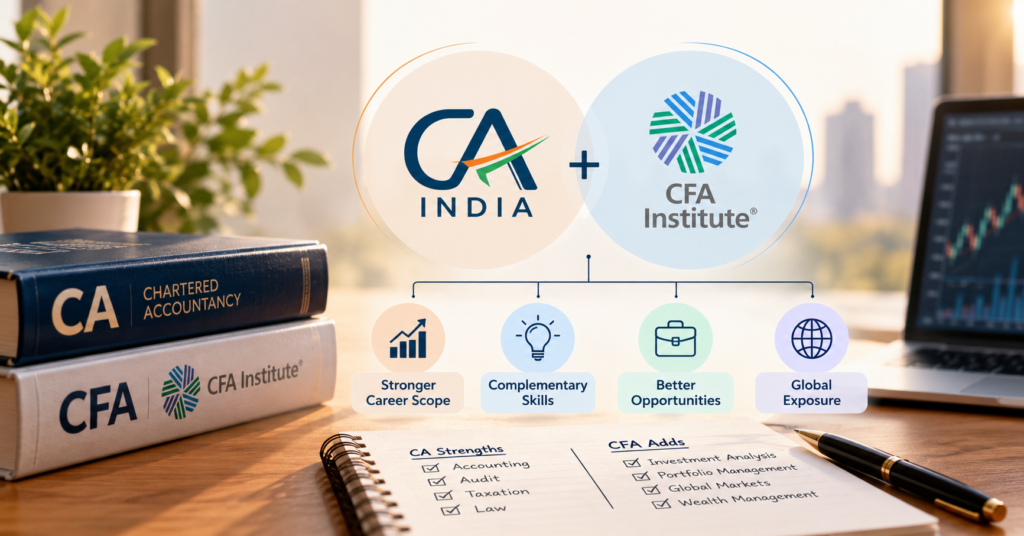
CA makes you strong in accounting, audit, tax and law. What it doesn’t give you is deep training in investing. CFA fills that gap.
You learn how to value a company, not just verify its numbers. You learn portfolio management, fixed income, derivatives and how markets price risk, and you also get a strong ethics framework, which matters in this line of work.
There’s a career benefit too. A CA with a CFA can move between two worlds. You can read a balance sheet like an auditor and then explain what it means for a stock price. In my experience, that combination is rare, and employers notice it.
What overlaps and what’s new
You won’t start from zero. Financial statement analysis, corporate finance basics and ethics will feel familiar. Your accounting background gives you a real head start in the financial reporting topics, and you’ll probably breeze through some of them.
But most of the curriculum will feel new. Quantitative methods, portfolio theory, derivatives and economics are the areas where CA students struggle. Don’t assume your CA knowledge will carry you through. The CFA exam tests how you apply ideas to investment decisions, which is a different way of thinking from CA.
Career scope after CFA for a CA Students
The most common destinations are equity research, investment banking, portfolio management, wealth management and asset management. Risk management and private equity are also good fits, and so is corporate finance, treasury and strategy inside large companies.
If you’re a CA working in practice and you want to move into the buy side or into research, CFA is one of the clearest signals you can give. If you want to stay in audit, tax or compliance, CFA adds less, and you might be better off going deeper into your own field. I’d say that plainly, because many students chase the CFA name without asking whether it fits where they’re headed.
Since 2025, Level 3 has three pathways: Portfolio Management, Private Markets and Private Wealth. You pick one when you register for Level 3 and you can’t change it afterwards. So, it helps to know early which direction you want.
How much time and effort does it take?
CFA Institute says the program typically takes three to four years, with a recommended 300+ hours of study per level. That’s a pattern, not a rule. Some people finish faster and some take longer.
For a CA student, the hard part isn’t intelligence. It’s time. CA articleship, exams and CFA together can burn you out. Many students do better by taking the CA Final first and starting CFA Level 1 after, or by starting Level 1 in a lighter phase. Only you know your schedule, so be honest with yourself.
Also remember the Practical Skills Module. At every level, you must complete at least one before your results are released. If you don’t, your result is voided, and you’ll have to register and pay again. It takes around 10 to 20 hours, so don’t leave it for the last week.
Is CFA worth it for a CA Students?
My honest answer is yes, if you want a career in investments. The two qualifications complement each other well. If you don’t care about markets, valuation and analysis, skip it. It’s a long, tough program, and the people who finish it are the ones who actually enjoy the subject.
Before you commit, check the current exam dates, fees and rules on the official CFA Institute website. Fees and deadlines change, and the official page is always the final word.
FAQs
No. CFA Institute doesn’t offer exemptions for CA, MBA or any other qualification. You have to clear Level 1, Level 2 and Level 3 like every other candidate. Please ignore anyone who says otherwise.
Yes, if you meet one of the entry routes. If you already have a bachelor’s degree, you can register. If you’re still in your degree, you must be within the allowed window before graduation. Check the official enrollment requirements before you pay anything.
It can count for entry if you’re using the work experience route, because paid articleships are accepted there. For the charter, though, the work must relate to investment decision making. Audit and tax work may not qualify, so use the official work experience assessment to check your role.
A little, but not by much. Financial reporting topics will feel familiar. Portfolio management, derivatives, quant methods and economics will not. Most CA students need to put in proper study hours for those parts.
CFA Institute says three to four years is typical for all three levels, with about 300 hours of study per level. Your own timeline depends on how many levels you pass on the first attempt and how much time your job leaves you.