


If you’re already working and thinking about what could be a best Finance Courses for Working Professionals , you’re probably stuck between two worries. One, will this actually help my career or is it just another certificate sitting in a folder. Two, can I even manage this alongside a full-time job. Both are fair questions, and honestly, the answer depends less on the course name and more on what you’re trying to get out of it.
I’ve worked around finance professionals for years now, some doing CMA US while working full time, some doing CFA on the side, some picking shorter certifications just to plug a specific skill gap. Here’s what actually makes sense for working professionals in India right now, and how to pick the best Best Finance Courses for Working Professionals that fits your situation instead of just chasing a popular name.
Table of Contents
Figure Out What Gap You’re Actually Trying to Close
Before picking a course, get honest about why you want it. Are you trying to move from accounting into a finance manager role? Do you want to shift into investment or research? Are you in a support function and want to move closer to decision making? Or do you just feel stuck and think a certification will fix that feeling?
That last one is where people waste the most money and time. A course only helps if it closes a real, specific gap between where you are and where you want to be. If you can’t name that gap in one sentence, spend a week figuring that out before you enroll in anything.
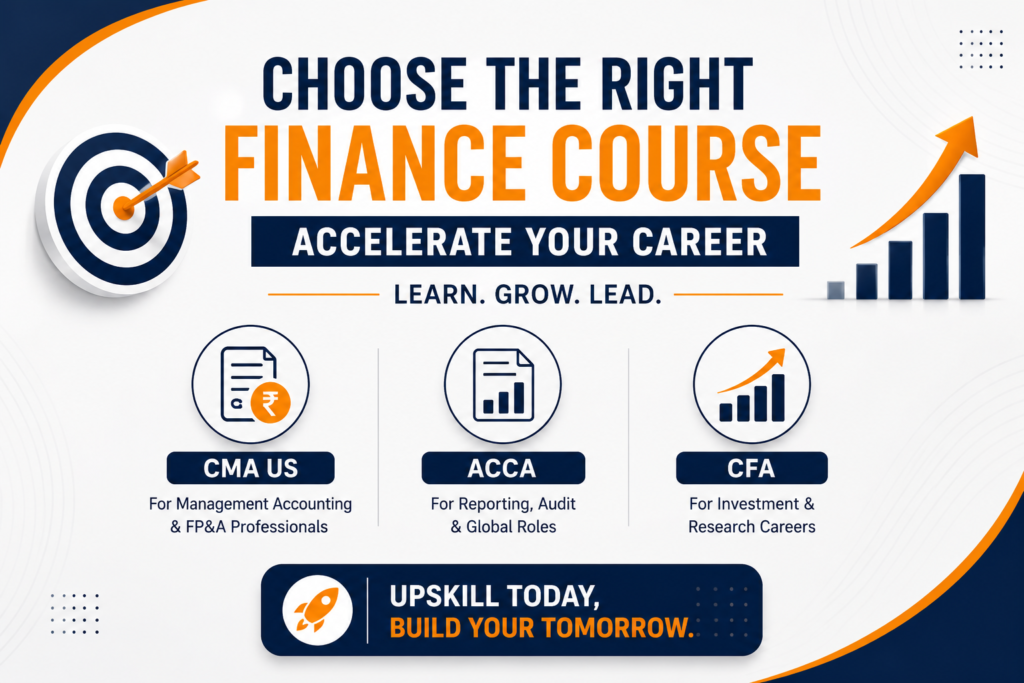
CMA US, If You Want to Move into Management Accounting or FP&A
CMA US works well for working professionals because the structure is flexible and the syllabus is directly usable at work. If you’re in accounting, controllership, or any role that touches budgeting and cost analysis, this qualification builds exactly the skills your next role will need.
The exam is split into two parts, and a lot of working professionals manage to finish it in twelve to eighteen months while still working. What makes it worth it is that the concepts, variance analysis, budgeting, decision-making tools, apply almost immediately to daily work, so you’re not just studying for an exam, you’re getting better at your actual job while you prepare for it.
ACCA, If You’re in Reporting, Audit or Tax and Want Global Recognition
If your work already involves financial reporting or audit, ACCA adds a layer of global credibility that’s genuinely useful if you’re eyeing roles at multinational companies or Big Four firms. It also works well if you’re a commerce graduate who didn’t go the CA route but wants something with similar weight in reporting and audit-heavy roles.
It takes longer than CMA US for most people, often two to three years alongside a job, but the depth in IFRS and financial reporting is hard to match with a shorter course. If your career goal specifically involves reporting or audit work with international clients, this is usually the stronger pick over CMA US.
Get More Details About ACCA
CFA, If You Want to Move Into Research, Investment or Portfolio Roles
CFA is a different animal entirely. It’s heavier, it takes longer, usually two and a half to four years across the three levels, and it demands real discipline while working full time. But if your goal is equity research, portfolio management, or anything markets-facing, there’s no real substitute for it.
A lot of working professionals underestimate how much self-study time CFA actually needs, especially at level two. Before starting, be honest about whether you can consistently put in ten to fifteen hours a week for months at a stretch. If your current job already eats most of your energy, this is worth thinking through carefully before you commit.
Shorter, Skill-Specific Courses If You Need Something Faster
Not everyone needs a multi-year qualification. If you already have a base qualification like CA, CMA, or an MBA in finance, and you just need a specific skill, financial modelling, equity valuation, Power BI for finance, investment banking basics, a shorter certification course does the job without the multi-year commitment.
These courses typically run anywhere from a few weeks to a few months and are useful when your gap is narrow and specific. Someone who already understands accounting but has never built a proper three-statement model doesn’t need a full new qualification, they need a focused modelling course.
Think About Format Before You Commit
For working professionals, format matters as much as content. Some courses are fully self-paced, which works if you’re disciplined but struggle with fixed schedules. Others have live weekend classes, which work better if you need structure and accountability to actually finish.
Check the exam windows too. CMA US and CFA both have fixed testing windows, so plan your work commitments around those months in advance. ACCA has more frequent sitting windows in India now, which gives a bit more flexibility if your work schedule is unpredictable.
Don’t Ignore the Cost Versus Payoff Conversation
Be realistic about cost. CMA US typically costs less overall compared to CFA or ACCA when you add up all the levels and materials, though this varies based on where you register and what study resources you use. CFA tends to be the most expensive across all three levels once you include prep material. ACCA sits somewhere in between depending on exemptions you might get based on your existing degree.
Before enrolling, actually check if your current company offers any reimbursement or sponsorship for these qualifications. A surprising number of mid-size and large firms do, especially for CMA US and ACCA, and it’s worth asking HR directly instead of assuming the answer is no.
Talk to People Who’ve Actually Done It
Before picking any course, find two or three people in your target role who’ve cleared the qualification you’re considering, ideally ones who did it while working. Ask them what the actual weekly time commitment looked like, not the marketing brochure version. Ask if it actually helped them move roles or if the role change happened separately. Real answers from people who lived through it are worth more than any course website’s promises.
Final Thought
There isn’t one universally Best Finance Courses for Working Professionals in India. There’s a best course for your specific situation, your current role, your target role, how much time you can realistically give it, and what your company might support. Get clear on that first, then pick the qualification that closes the actual gap rather than the one that sounds most impressive on LinkedIn.
Frequently Asked Questions
There’s no single best option. CMA US suits people moving into management accounting or FP&A, ACCA fits reporting and audit-focused careers, and CFA is the right choice for investment and research roles. The right pick depends on your target role, not on which course is most popular.
Yes, a lot of working professionals do exactly this. CMA US is often manageable in twelve to eighteen months alongside a job because of its two-part structure. CFA takes longer, usually two and a half to four years, and needs a heavier weekly time commitment, especially at level two.
It can be, particularly if you’re aiming for reporting or audit roles at multinational firms or Big Four companies. Many candidates with a B. Com background also get exemptions on certain papers, which shortens the overall timeline.
Depends on your gap. If you need a broad credential to shift career direction, a full qualification like CMA US, ACCA or CFA makes sense. If you already have a base qualification and just need a specific skill, a shorter course focused on that skill is usually the faster and more practical option.
Many mid-size and large companies do offer partial or full sponsorship, especially for CMA US and ACCA, but it’s rarely advertised openly. It’s worth asking HR directly rather than assuming your company doesn’t support it.