

Table of Contents
CMA US Eligibility for Indian Students: A Simple Guide
If you’ve been researching finance certifications and CMA US keeps coming up, you’re probably wondering whether your degree even qualifies you to sit for it. Good news first: eligibility for CMA US is a lot more relaxed than most Indian students expect. There’s no strict cutoff based on percentage, no rigid list of “approved” degrees, and no waiting years before you can start. Let’s actually walk through what you need.
What CMA US actually is
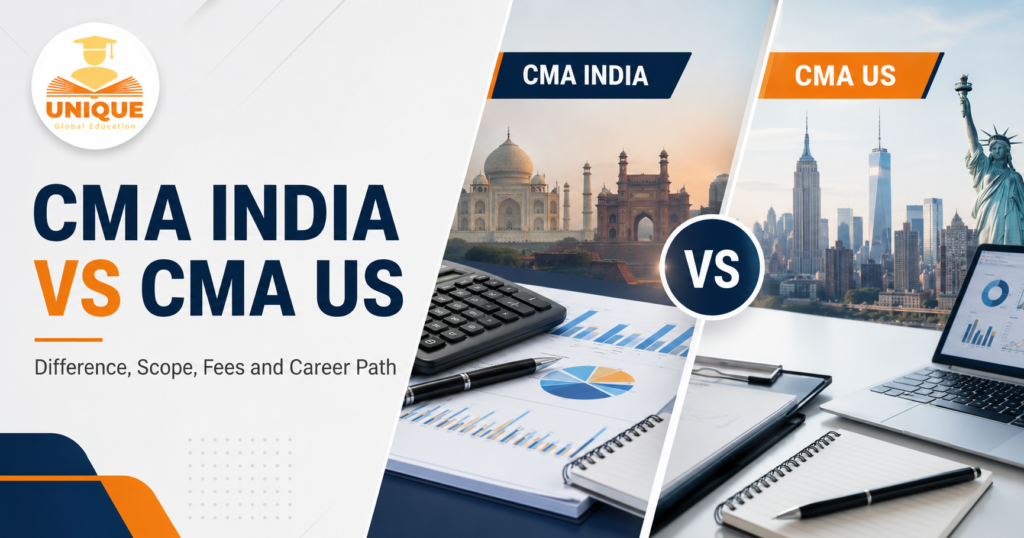
CMA US stands for Certified Management Accountant, and it’s issued by the Institute of Management Accountants, or IMA, based in the United States. It’s not the same thing as CMA India, which comes from ICMAI and follows an entirely different structure with its own Foundation, Intermediate, and Final levels. A lot of confusion online happens because people mix these two up, so it’s worth getting that straight before you go any further. If you’re aiming for a global finance career, especially something in FP&A, corporate finance, or business analytics, it’s the US version most people mean.
The education requirement
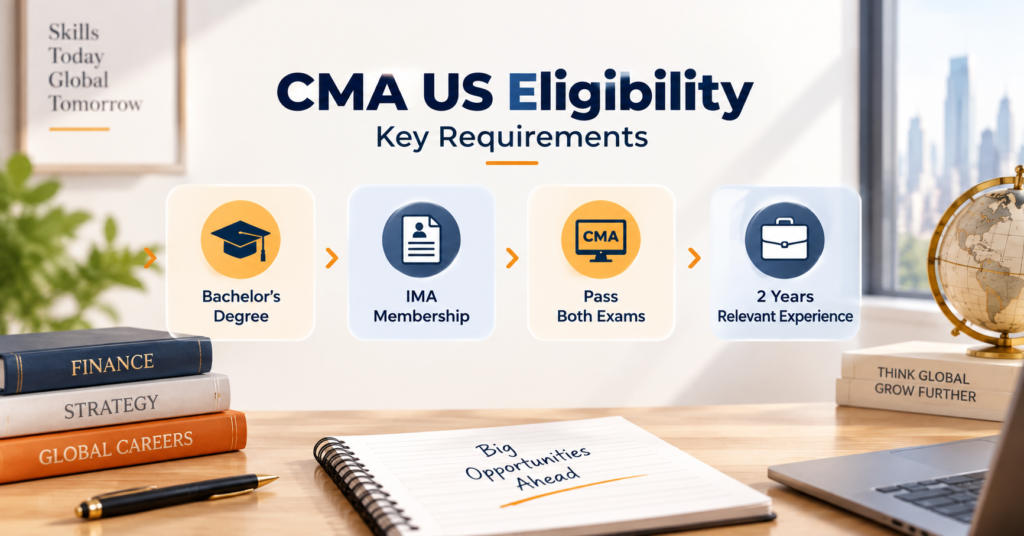
You need a bachelor’s degree from a recognized institution. That’s the baseline. For Indian students, this usually means a degree from a university recognized by UGC or AICTE, and yes, B. Com fits comfortably here. So does BBA, BMS, or even an MBA if you went that route. IMA doesn’t demand a specific stream, so students from commerce, economics, or even unrelated fields can apply as long as the degree itself is legitimate.
If your degree is from an institution IMA doesn’t automatically recognize, you’ll need to get it evaluated for equivalency, usually through an agency like WES. It’s an extra step, not a dead end, so don’t panic if your college isn’t on some famous list.
Here’s the part that surprises people the most. You don’t actually need to have finished your degree before you start the exams. Final year students can register and appear for both parts of the CMA exam while still in college, as long as they submit proof of graduation once they actually have it. A lot of B. Com students use this to their advantage and clear one or both papers before they’ve even picked up their final mark sheet.
Get More Details About CMA US
The work experience requirement
Alongside education, CMA US asks for two years of relevant professional experience in management accounting or financial management. The word “continuous” matters here, so scattered short stints usually don’t count the way a steady two-year run does.
What really works in your favour is the timing. You don’t need this experience before you take the exams. You can complete it within seven years after passing both parts. So, a student who clears CMA US right after graduation has plenty of room to build up the required experience while working a regular finance job, rather than being forced to find a role first and study around it.
IMA membership and the exam itself
Before you can register for the exams, you’ll need to become an IMA member. This isn’t optional, it’s baked into the process, and it also gives you access to study resources and updates on exam changes. After that comes the CMA entry fee, followed by registration for Part 1 and Part 2 of the exam separately.
The exams themselves are held at Prometric centers, and there are several locations across India, so you don’t need to fly anywhere to take them. The content leans heavily into strategy, planning, and analysis rather than the compliance-heavy style Indian students are usually trained for in college. That shift takes some adjusting to, but it’s also exactly why the qualification is valued the way it is internationally.
No age limit, and that actually matters
Unlike some certifications that expect you to be at a certain career stage, CMA US has no age restriction at all. Whether you’re a fresh graduate, a working professional a few years into your career, or someone considering a shift into finance from another field, none of that disqualifies you. This flexibility is part of why it’s picked up so much traction among Indian students recently, since it doesn’t force you into a narrow window to get started.
CMA US Eligibility Example for an Indian Students
Say you’ve just finished B. Com from a Delhi university. You don’t need to redo any part of your degree or clear an English proficiency test. What you actually need to do is register as an IMA member, enroll with a training provider if you want structured prep, and start attempting Part 1 and Part 2 while you’re still in your final semester if you feel ready. Once you graduate, you submit your degree proof, and from there you spend the next couple of years gaining relevant finance experience, maybe as a financial analyst or in a similar role. Put those pieces together and you’ve met every requirement without needing anything beyond what a standard B. Com already gives you.
Should you start CMA US right after B. Com or wait
This genuinely depends on what you want out of the next few years. Starting early means you clear the exams while your accounting fundamentals are still fresh from college, and you get the work experience clock ticking sooner. On the other hand, some students prefer working for a year or two first, so they understand what management accounting actually looks like in practice before they sit for exams built around that exact perspective. Neither approach is wrong. It just depends on whether you learn better through theory first or through some real exposure before you commit to the syllabus.
FAQs
Yes, and honestly this is the most common path I see. Your B. Com degree alone is enough to meet the education requirement, so there’s no extra course or bridge qualification you need to chase before applying.
Not at all, which surprises a lot of people. You can go ahead and clear both parts of the exam first, then take up to seven years after that to complete your two years of relevant work experience.
No, and this mix-up trips up more students than you’d think. CMA US is run by IMA in America, while CMA India comes from ICMAI and works on its own separate levels and structure entirely.
Yes. You can register and even sit for the exams while you’re still finishing your degree, you’ll just need to hand in your graduation proof once it’s actually in your hands.
None. Whether you’re 21 and fresh out of college or well into your career and switching paths, age was never part of the eligibility criteria to begin with.