



I still remember a placement interview from a few years ago where the panel asked me, out of nowhere, to build a basic three-statement model on the spot. I knew accounting cold at that point. At that point, I could tell you what EBITDA meant, how depreciation schedules worked, and every ratio you could think of. But I hadn’t spent enough time practising financial modelling, and that gap became obvious the moment I had to put all that knowledge into an actual working model.
But when it came to actually linking an income statement to a balance sheet to a cash flow statement in real time, on a blank Excel sheet, with someone watching, I fumbled badly. Didn’t get the offer. But that one bad twenty minutes taught me more about the gap between “knowing finance” and “doing finance” than three years of college ever did.
That gap is basically what financial modelling fills. In plain terms, it’s building a working spreadsheet that represents how a company’s finances behave, and how they might behave going forward, based on assumptions you plug in yourself. Revenue growth, cost trends, capital spending, how the business is financed.
A model isn’t just a spreadsheet with numbers sitting in it. It’s meant to answer a question. Should we buy this company. Is this project worth funding. What’s this stock actually worth. Will this LBO generate the return the PE fund is promising its investors. Bankers use models before pitching a merger.
PE guys use them before writing a cheque for a leveraged buyout. Corporate finance teams use them for budgeting and capital allocation. Equity research analysts build them to justify a price target. Even a founder pitching investor should, ideally, have one, though half of them show up without.
Table of Contents
Visit Unique Global Education for more Finance Related Updates
Why Financial Modelling Actually Matters If You’re Still Studying
Nobody really says this out loud in college, so I will. A finance degree teaches you the language of the subject. It doesn’t teach you how to use that language to solve an actual business problem while someone’s watching the clock. Modelling is where that translation happens.
When you sit down to build one, you’re not just typing numbers into cells. You’re constantly making calls. Does this company grow revenue at 8% next year or 12%? Does that number even make sense given what their competitors are doing? Is that expense a one-off or something that’ll show up every year?
These are judgment questions, not memory questions, and answering them repeatedly is what starts turning a student into something closer to an analyst.I’ve watched this play out more times than I can count while mentoring juniors. Two candidates, similar marks, similar resumes. One can explain ratio analysis nicely in words.
The other opens Excel and builds a working model with sensitivity checks in under an hour. It’s rarely a close call for the interviewer.There’s a second benefit nobody mentions much, and honestly it took me a while to notice it myself. Building models with a best case, base case, and worst case teaches you to stop thinking about business outcomes as fixed numbers.
Real companies don’t move in straight lines. A key client leaves, input costs jump, a competitor undercuts pricing. Once you’ve built enough scenarios, you start thinking in ranges instead of certainties, and that habit sticks with you well beyond whichever specific job you end up taking.
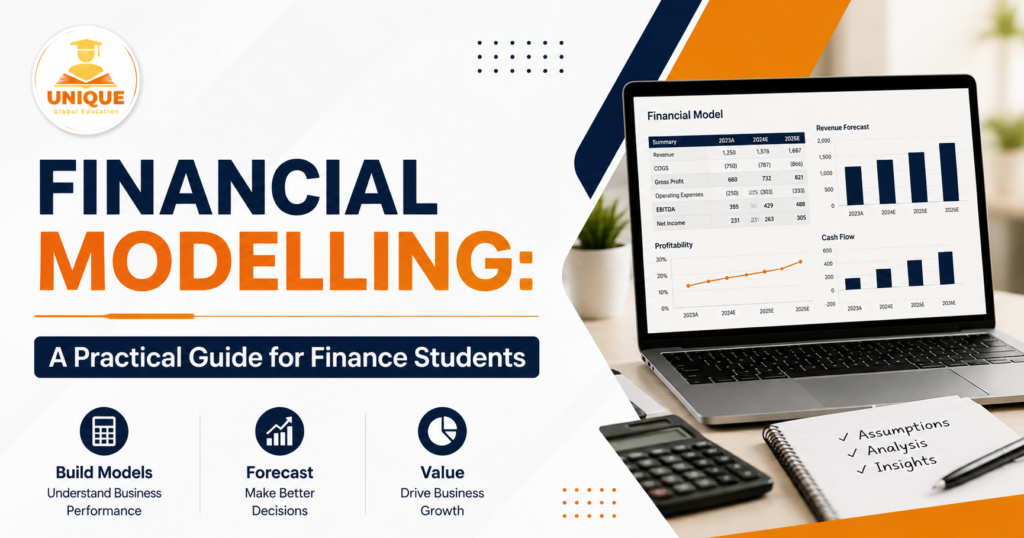
What Learning It Actually Looks Like
Students tend to assume financial modelling is some rare, near mythical skill locked away for a handful of bulge bracket analysts. It isn’t. The foundation is stuff you already have, or should have, from your degree – basic accounting logic, some Excel comfort, and the ability to reason about how cash moves through a business.
Where people actually get stuck is the linking. Assumptions feed the income statement. That feeds the balance sheet. That feeds the cash flow. And the balance sheet has to actually balance at the end, with error checks built in so you know immediately if something’s broken.
Getting comfortable with that flow is where most of the real learning happens, honestly more than any valuation technique that comes after it. Once that’s solid, you move into DCF, comparable company analysis, precedent transactions, whichever direction suits the role you’re chasing.
The reassuring part is that this skill responds well to repetition in a way a lot of finance topics don’t. You don’t need five years of market exposure to get decent at it. Build eight or ten models across different sectors and you’ll notice a real jump in your speed and your instinct for where things usually go wrong.
If you’re on the fence about when to start, don’t wait for placement season to force your hand. Pick a company whose business you’re actually curious about, pull its annual report, and try building something yourself before any course tells you how. The mistakes you make on your own teach you more than watching a polished model get built by someone else on a projector screen.
FAQs
No, and honestly waiting until you’re “Excel ready” is a bit of a trap. Basic formulas and cell referencing are enough to start. Things like index match, data tables, dynamic charts – you’ll pick these up naturally as you build more models, not before.
That’s probably the most common misunderstanding I run into. Yes, IB and PE roles demand strong modelling. But FP&A, corporate finance, credit analysis, equity research, even running your own business someday – all of it involves forecasting and evaluating numbers, and modelling is the skill underneath that.
Depends entirely on how much you practice versus how much you just watch tutorials. Most students who build models consistently start feeling reasonably confident in two to three months. Getting to the kind of speed bankers show off in interviews usually takes closer to six months to a year of real, repeated practice.
Yes. Some of the strongest modellers I’ve worked alongside had neither when they started out. This is a practical skill, not a credentialed one. A B. Com already gives you the accounting base you need – what actually matters is whether you’re willing to sit and build models over and over.
Jumping straight into DCF or complex valuation before the basic three statement model is solid. I’ve seen students attempt a full valuation without properly understanding how depreciation flows into the cash flow statement. Nail the fundamentals first. The complicated stuff can wait.