


Dropping CA is one of the hardest calls a commerce student makes. You’ve already given years to it, maybe cleared a group or two, and then one day the math just stops adding up. The exam cycle wears you down, articleship takes over your routine, and at some point, you start wondering if this is really the path for you anymore. That’s usually when students begin looking at CA Dropout Career Options and thinking seriously about what they can do next.
If that’s where you are right now, you’re probably not looking for sympathy. You want a straight answer. What next?I’ve spent a good chunk of my career around CA firms and finance content, and here’s what I’ve noticed. A CA dropout isn’t a failure story, it’s a redirection.
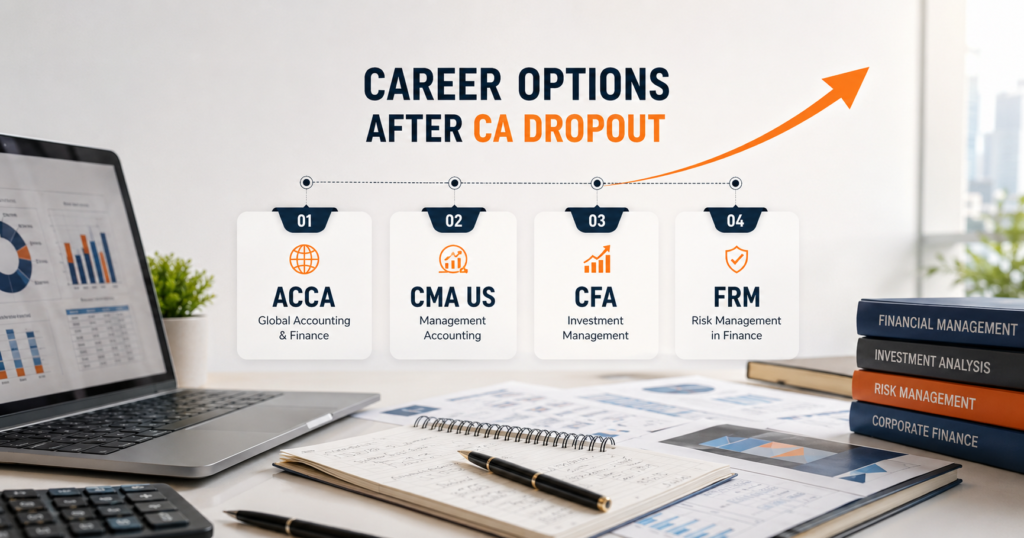
Whatever you picked up while attempting CA, accounting basics, tax exposure, the sheer discipline of studying for hours on end, none of that disappears. It becomes the foundation for whatever comes next. The real question is which door you walk through: ACCA, CMA US, CFA, or FRM.
Table of Contents
ACCA: The Closest CA Dropout Career Options for CA Student
If you left CA after clearing a few groups, ACCA will feel oddly familiar. The syllabus overlaps a lot with CA, especially in financial reporting, audit, and tax. Most institutes even give exemptions based on how far you got in CA, so you’re not starting from scratch.
ACCA is technically a UK qualification, but it’s become genuinely global at this point. It opens doors at Big 4 firms, MNCs, and shared service centers, mostly in roles around financial reporting, internal audit, and advisory work. What makes it appealing for a CA dropout is that the papers feel like a continuation, not a whole new subject you’re learning from zero.
There’s a catch though. ACCA in India still doesn’t carry the same weight as CA when it comes to domestic statutory audit. You won’t be signing off on Indian tax returns the way a practicing CA does. But if your target is corporate finance, MNC roles, or work abroad eventually, ACCA gets you there smoothly.
Most people with a CA background finish ACCA in about 12 to 18 months thanks to the exemptions. That speed matters a lot when you’ve already burned years chasing one qualification.
Get More Details About ACCA, CMA US, CFA or FRM
CMA US: Built for Corporate and Management Roles
CMA US is a different animal altogether. Where CA and ACCA lean toward audit, tax, and reporting, CMA US is built around management accounting, budgeting, cost control, and financial strategy inside a company. Think FP&A, budgeting analyst, or management accountant, not external audit.
For a CA dropout, this shift can actually feel like a relief. If part of why you walked away from CA was the audit grind or the articleship pressure, CMA US pulls you into a completely different world. You’re working with a company’s internal numbers, helping leadership make decisions, instead of signing off on statutory filings.
The exam structure is also far more forgiving. Two parts, computer-based testing available nearly year-round, and a realistic finish time of 12 to 18 months if you stay consistent. That kind of predictability feels good after the chaos of the CA exam calendar.
CMA US works especially well if you already picked up some articleship exposure to costing, MIS, or internal financial processes. That experience translates directly into interview conversations down the line.
CFA: For Those Drawn to Markets, Not Compliance
If audit and tax never really excited you, and you found yourself more curious about how companies get valued or how markets move, CFA deserves a real look.
CFA is built around investing and markets. It suits people aiming for equity research, portfolio management, investment banking, or corporate finance roles centered on valuation and financial analysis. It’s a completely different mental world from CA’s compliance-heavy focus, and that’s exactly why some CA dropouts end up thriving here.
But be honest with yourself before jumping in. CFA demands strong comfort with numbers and genuine curiosity about financial markets. It’s also a three-level exam with a pass rate that keeps everyone humble, and each level usually needs 300-plus hours of study. This isn’t a quick pivot. It’s a multi-year commitment, typically two to four years depending on how consistently you clear each level.
What makes CFA attractive for a CA dropout is the recognition. Recruiters in investment banking and asset management take the charter seriously, and your CA-era accounting background gives you a genuine edge over candidates coming purely from a finance degree.
FRM: The Niche but Powerful CA Dropout Career Options
FRM, or Financial Risk Manager, is narrower than the other three, and that narrowness is exactly its strength. It’s built specifically for risk management roles: credit risk, market risk, operational risk, and increasingly, roles tied to regulatory compliance at banks and NBFCs.
If audit felt too broad and compliance-heavy during your CA days, but you still enjoyed the analytical, numbers-driven side of finance, FRM might surprise you. Risk teams at banks, insurance companies, and financial institutions actively look for people who understand both accounting and quantitative risk models, and that combination describes a CA dropout with some articleship exposure pretty well.
FRM has two parts and can realistically be wrapped up in 12 to 18 months. It’s faster than CFA and more specialized than CMA US or ACCA. The tradeoff is a smaller, more specific job market. You’re not chasing generalist finance roles here; you’re aiming squarely at-risk functions.
So, Which CA Dropout Career Options Should You Actually Pick?
There’s no single right answer here, and anyone claiming otherwise is probably selling a course. Ask yourself three questions honestly.
Do you want to stay close to accounting, reporting, and audit work, just with global recognition attached? Lean toward ACCA.
Do you want to move into internal corporate roles like budgeting, costing, and FP&A, away from external audit entirely? CMA US fits that shift well.
Are you genuinely drawn to markets, valuation, and investment decisions rather than compliance? CFA is worth the multi-year investment.
Do you want a focused, faster path into risk management specifically at banks and financial institutions? FRM gets you there efficiently.
Whichever you pick, remember your CA attempt wasn’t wasted time. It gave you a technical grounding most fresh graduates simply don’t have. Use that as leverage in interviews, not something to downplay or hide.
Frequently Asked Questions
More than you’d think. I’ve seen this pattern play out again and again with people who attempted CA and later moved to one of these four. Employers and institutes are used to it too, so nobody bats an eye when they see it on a resume. Your accounting base from the CA attempt carries over well, which is honestly why the switch works.
If speed matters to you, CMA US and FRM usually get you there quickest, somewhere around 12 to 18 months if you stay consistent. ACCA can move fast too, especially since your CA papers often qualify you for exemptions that shave months off the timeline.
It matters more than people expect. Whatever exposure you got during articleship, whether that was audit, tax, or costing work, tends to become a real talking point in interviews later. Recruiters notice it, and it’s not something you need to downplay just because you didn’t finish CA.
That really depends on why it wasn’t working. CFA isn’t an easier escape route; it’s just a different kind of hard. Instead of compliance and audit, you’re dealing with markets and valuation, and it still takes years to get through. Go for it because markets genuinely interest you, not because you’re trying to dodge CA’s format.
Yes, and plenty of people do exactly that. All four qualifications were built with working professionals in mind. CMA US and FRM make this especially manageable since their computer-based exams run on flexible windows throughout the year, so you’re not stuck waiting for one fixed exam date like with CA.