

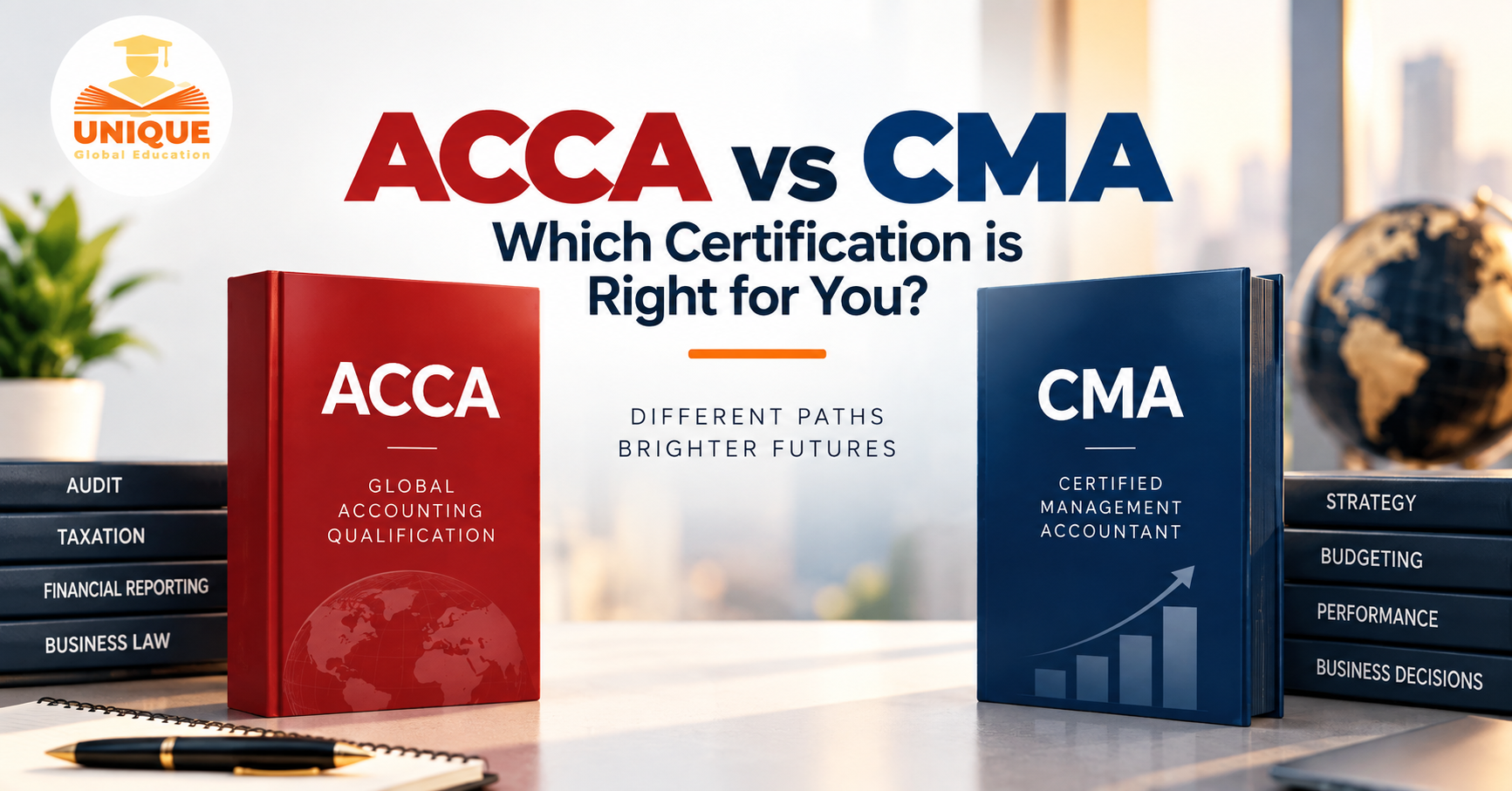
I get this question a lot. Someone is sitting at their desk, maybe a few years into their accounting career, and they are wondering which certification is going to actually move the needle for them. ACCA vs CMA? Both sound impressive. Both cost real money and real time. And both have passionate supporters who will tell you theirs is the best one.
The truth is, neither certification is universally better. They are just built for different kinds of careers and different kinds of people. Once you understand what each one actually stands for and where it takes you, the choice becomes a lot clearer. So let me walk you through it properly.
Table of Contents
What is ACCA?
ACCA stands for Association of Chartered Certified Accountants. It is a UK-based qualification but it is recognized in over 180 countries, which is honestly what makes it so attractive. When you earn the ACCA, you are telling the world that you understand financial reporting, taxation, audit, law, and strategic business management at a professional level.
The qualification has multiple exams spread across three levels called Applied Knowledge, Applied Skills, and Strategic Professional. You also need to complete an Ethics and Professional Skills module and accumulate three years of practical work experience before you can call yourself a fully qualified ACCA member.
What makes ACCA unique is how flexible it is. You can study at your own pace, sit exams in over 100 countries, and work at the same time. A lot of people take four to five years to finish it while holding down a full-time job, and that is perfectly normal and accepted within the ACCA community.
Get More Details About ACCA
What is CMA?
CMA stands for Certified Management Accountant. It is awarded by the Institute of Management Accountants, which is based in the United States, but the CMA itself has a strong global presence especially in countries like China, the Middle East, and India where corporate finance roles are growing fast.
The CMA has two parts. Part one covers financial planning, performance, and analytics. Part two covers strategic financial management. That is it. Two exams, plus two years of relevant work experience, and you are a CMA. It is much more focused and faster to complete than the ACCA.
The philosophy behind the CMA is different from ACCA. It is not trying to make you an expert in everything accounting-related. It is specifically designed to prepare finance professionals who work inside companies, helping leadership make better business decisions through data, forecasting, budgeting, and strategy. Think CFO track, think FP&A, think business partnering.
Get More Details About CMA US
ACCA vs CMA: The Key Differences
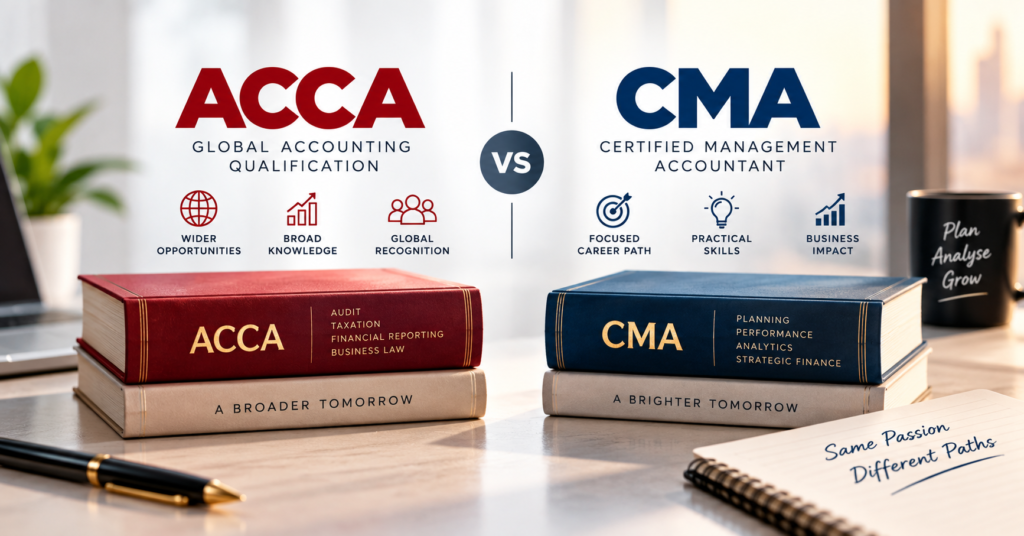
ACCA vs CMA: Scope and Focus
ACCA is a broad qualification. It covers public accounting, audit, taxation, financial reporting, and management accounting all in one package. If you want to be a well-rounded accountant who can work in many different areas, ACCA gives you that breadth.
CMA is a narrow qualification, but narrow in the best possible way. It goes deep into management accounting and corporate finance. If you already know you want to work in a company as a finance business partner, a financial controller, or eventually a CFO, the CMA is laser-focused on exactly those skills.
ACCA vs CMA: Time to Complete
ACCA typically takes three to five years depending on how many exam exemptions you get based on your existing qualifications and how fast you can move through the papers. It is a long commitment and you need to respect that going in.
CMA can realistically be completed in one to two years. Many people finish both parts within a year if they study consistently. For someone who wants results relatively quickly, this is a meaningful advantage.
ACCA vs CMA: Global Recognition
ACCA wins on pure geographic reach. With recognition in over 180 countries and strong demand in the UK, Europe, Africa, Asia, and the Middle East, it is genuinely one of the most portable qualifications in the world. If you ever want to work in multiple countries throughout your career, ACCA is the safer long-term bet.
CMA is recognized globally too, especially in the US, Canada, China, the Gulf region, and India. But if you want to work in, say, a small European country or an African market, ACCA will open more doors simply because it is more familiar to local employers there.
ACCA vs CMA: Salary and Career Outcomes
Both certifications are associated with strong salary outcomes, and both are backed by data. The IMA’s annual salary survey consistently shows that CMAs earn significantly more than non-certified management accountants, sometimes 60 percent more when you factor in bonuses. That is a meaningful number.
ACCA members also earn well above average, and the qualification gives access to a very wide range of roles from Big Four firms to corporate finance to public sector work. The salary premium depends heavily on which country you are working in and which sector you choose.
ACCA vs CMA: Who Hires Them
ACCA is highly valued by public accounting firms, audit firms, and employers in sectors where technical accounting knowledge matters a lot. If you want to work at a Big Four firm, a mid-tier accounting practice, or in a country where chartered accountancy is the standard, ACCA is what those employers are looking for.
CMA is highly valued by corporations. Manufacturing companies, technology firms, financial services companies, and multinationals actively seek out CMAs for their finance teams because these professionals understand how to translate financial data into business strategy. If you want to work in industry rather than practice, CMA speaks directly to what those employers need.
Which One Should You Choose?
Here is how I think about it. Ask yourself one honest question. Do you want to work for an accounting firm, practice, or do consulting and audit work across many clients? Or do you want to work inside a company and help that company grow and make better decisions?
If your answer is the first one, go with ACCA. It is built for that world and employers in that world know and trust it deeply.
If your answer is the second one, go with CMA. It is built specifically for corporate finance and management accounting, and it will signal to any company you apply to that you think like a business partner, not just a bookkeeper.
If you are outside the US and want maximum career flexibility across different countries and sectors, ACCA is probably the safer investment. If you are already in corporate finance and want to move up faster with a focused credential that takes less time, CMA is the smarter move.
And if you are genuinely unsure, talk to people who are already working in the roles you want. Ask them what their employers actually care about. Real conversations with real professionals in your target field will tell you more than any comparison article ever could, including this one.
Frequently Asked Questions
Yes, you can and some people do. A few ACCA members go on to pursue the CMA to strengthen their management accounting credentials, especially if they move into corporate roles. However, most people find that one qualification is enough to build a very strong career. Do one, get the experience, and then evaluate whether the second one makes sense for your specific goals.
It is a different kind of challenge rather than easier or harder. ACCA has more exams and a broader syllabus so the volume of material is much higher. CMA has fewer exams but the two papers are very demanding in their own right. People who struggle with CMA often say it is the depth of the strategic financial management content that catches them off guard. Neither one is a walk in the park.
Both are well recognized in the Gulf region and the Middle East generally. ACCA has a very long history there and is widely understood by employers. CMA has been growing rapidly in that region over the last decade and is especially popular in Saudi Arabia and the UAE for corporate finance roles. If you are targeting a specific country or company, research what their finance teams actually hold and that will give you your answer.
Both do. ACCA requires three years of relevant practical experience. CMA requires two years of professional experience in management accounting or financial management. You can sit the exams before completing the experience requirement, but you cannot use the designation officially until the experience is verified and approved.
Honestly, it depends more on where you work and what role you are in than which certification you hold. CMA holders in senior corporate finance roles in the US and Middle East often report very high compensation. ACCA members in Big Four firms and financial services companies also earn very competitive salaries. Both credentials give you a genuine earnings advantage over non-certified peers in their respective domains.
Are you are a recent graduate with an accounting or finance degree, check whether your degree gives you any ACCA exemptions first. If it does, ACCA becomes faster and more efficient for you. If you already know you want to go into corporate finance and management roles, start with CMA because it will get you credentialed and working in your chosen field faster. Your long-term career direction matters more than which exam you take first.
At the end of the day, both ACCA and CMA are genuinely respected credentials that can open real doors for your career. The best one is the one that matches where you actually want to end up. Stop overthinking it, pick the one that fits your career vision, make a study plan, and start. Future you will be glad you d