

Every few weeks, a student messages me asking the same thing: CMA India vs CMA US — which one should I choose? Honestly, half the confusion comes from the name itself. They are two completely different courses, offered by two different professional bodies, but they just happen to share the same three letters.
Table of Contents
What CMA India Actually Is
CMA India comes from the Institute of Cost Accountants of India, the body most people still call ICWAI out of habit. This is a cost accounting qualification, and it’s not just academic. Indian law requires companies past a certain turnover to maintain cost records and get them audited.
That audit has to be signed by someone with this exact credential. So, there’s real legal weight behind it, not just a certificate on a wall.You can start this course right after your 12th boards, which is a big reason so many students pick it early instead of waiting to finish their degree first.
There are three stages here, Foundation, Intermediate, and Final, and on top of clearing the exams you also need to log practical training hours before ICMAI hands you the final certification.Where does this qualification actually take you?
Mostly toward Indian manufacturing firms, PSUs, and government-linked companies that need cost audits done. If your plan involves staying rooted in the Indian system and doing compliance-heavy finance work, this is the one built for you.
What CMA US Actually Is
Now flip to CMA US. This one comes from the IMA, the Institute of Management Accountants, headquartered in the States. Forget cost audits for a second. This qualification is built around management accounting and strategic finance.
Budgeting, forecasting, internal controls, performance analysis, the stuff that shapes how a company actually makes decisions rather than just how it reports what already happened.Here’s what throws people off. Everyone assumes an international course must be longer and harder to structure around. It’s actually the opposite.
CMA US has just two parts. Part 1 deals with financial reporting, planning, performance, and analytics. Part 2 goes into strategic financial management. You’ll need a bachelor’s degree plus two years of relevant experience to get fully certified, though nothing stops you from writing the exams before that experience requirement is complete.
Because IMA operates globally, this credential travels well. The US, obviously, but also the Middle East, Southeast Asia, and a growing number of Indian multinationals that want finance teams who think in global terms.
Get More Details About CMA US Or CMA India
CMA India vs CMA US: Where the Two Actually Diverge
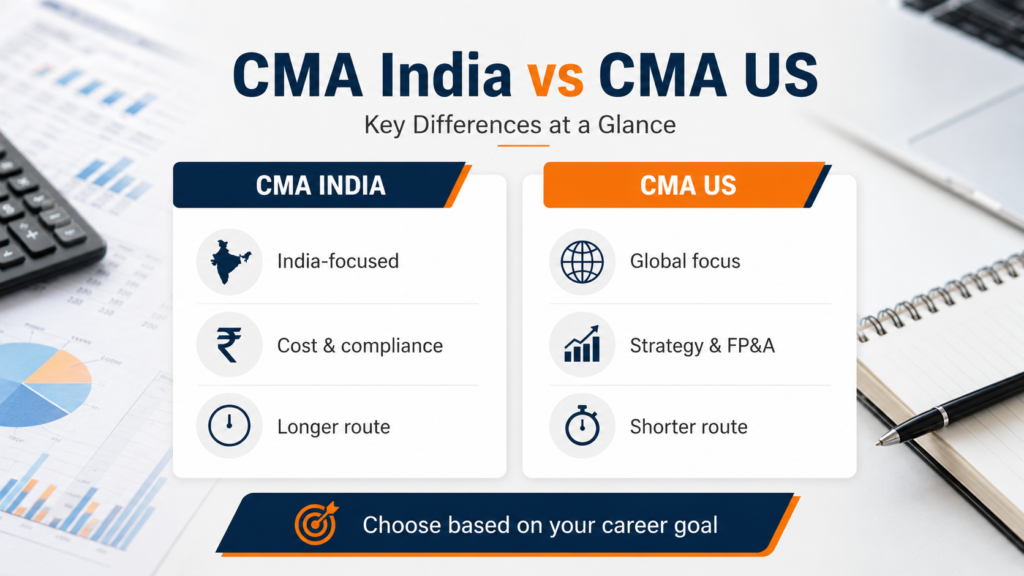
Strip away the branding and the difference comes down to purpose. CMA India is built around cost control and statutory compliance inside the Indian regulatory framework. CMA US is built around strategy and decision-making for companies operating on a global scale.
Time investment isn’t close either. CMA India usually eats up two to four years once you factor in all three levels and the training period. CMA US, if you’re disciplined about it, can genuinely be finished in twelve to eighteen months since there’s just two exams standing between you and the letters after your name.
And recognition plays out differently too. CMA India has legal standing here because of the statutory audit requirement I mentioned earlier. CMA US doesn’t have that same legal backing within India, but walk into an MNC finance department and it carries serious weight, particularly for FP&A and budgeting roles.
Let’s Talk Fees, Because This Matters
Money is usually what tips the decision, so I’m not going to dance around it.
CMA India is the cheaper route by a wide margin. Across all three levels, counting registration, study material, and exam fees, most students end up spending somewhere between 60,000 and 90,000 rupees. That number moves depending on how many attempts a level takes you, obviously.
CMA US asks for more upfront. Between the IMA membership, entrance fee, exam fees for both parts, and study material from providers like Gleim or Hock, you’re realistically looking at 1.5 to 2.5 lakh rupees total. Some coaching providers now sell bundled IMA-approved packages that make budgeting a bit more predictable, but the overall cost still sits noticeably higher than CMA India.
I wouldn’t call either course expensive or cheap in isolation. It depends entirely on the return you’re chasing. If CMA US lands you an MNC finance role, that higher fee pays itself back fast.
Career Outcomes and What You Can Expect to Earn
CMA India graduates typically end up in cost accounting, internal audit, statutory cost audit work, and finance roles across Indian manufacturing companies and PSUs. Fresh graduates usually start somewhere between 4 and 8 lakhs annually, and that climbs meaningfully once you move into senior cost accountant or finance controller positions.
CMA US graduates tend to land in FP&A, corporate finance, budgeting, and management reporting, whether that’s within an Indian MNC or somewhere abroad. Starting pay skews higher here, especially if you land with a US-linked employer, often falling between 6 and 12 lakhs for freshers in India, with considerably more room to grow if you end up in a global role.
Something I’ve noticed more often lately: students aren’t always choosing one over the other. Since CMA US only demands two exams, a lot of them are stacking it alongside CMA India or their B. Com degree, using it to strengthen an MNC-facing resume while still holding onto the statutory value CMA India provides.
CMA India vs CMA US: Which One Should You Actually Pick?
Start by asking where you actually want to work, not which course sounds more impressive at a family gathering. Government roles, PSUs, or anything tied to statutory cost audits in India point you toward CMA India. Corporate finance with MNCs, global exposure, or US-linked companies points you toward CMA US.
I won’t pretend there’s one right answer because there isn’t. When comparing CMA India vs CMA US, I’ve watched students build solid careers off either path, and I’ve watched others combine both to keep their options open. The real mistake is picking based on prestige instead of picking based on where you actually want to land.
Frequently Asked Questions
Honestly, yeah, a lot of people do this. CMA US is only two papers, so it doesn’t really compete for your time the way you’d expect. Most people run it parallel to CMA India or their B. Com and it doesn’t mess up either schedule.
Hard to give a straight answer here because they’re hard in different ways. CMA India just has more exams and takes longer, so it wears you down more than it stumps you. CMA US crams a lot into two papers, so it’s dense – you’re not doing it for years, but what you do cover, you need to know cold.
It matters, but not everywhere the same way. If you’re going for an MNC or a company with US connections, recruiters know what it is and it counts for something. Where it doesn’t help you is statutory work – cost audits under Indian law need CMA India, full stop, no substitute.
Two years, and IMA is fairly strict that it has to be relevant experience. But nobody’s making you do it in order – clear your exams whenever, and knock out the experience part before or after.
If it’s an MNC finance role you’re after, CMA US usually moves quicker just because it’s shorter and international companies recognize it without much explanation. CMA India’s still the stronger card for PSU jobs and manufacturing companies back home, especially anything touching statutory audit.