

I get this question a lot from people at work, usually over coffee or in a quick chat after a meeting. They’re eyeing ACCA for Working Professionals, genuinely excited about what it could do for their career, and then this wave of dread hits. How am I supposed to study for thirteen papers while I’m already drowning in month end closings and client calls?
Fair worry. I won’t pretend ACCA for Working Professionals is light work. It’s not. But it’s also one of the more forgiving qualifications out there if you’re already employed, honestly more forgiving than most people assume before they actually look into how it’s structured. I’ve watched articling accountants get through it, finance folks with brutal travel schedules, even a guy on my team who switched from an engineering background entirely. None of them had spare time lying around. They just worked with what they had.
Table of Contents
The Exam Structure Is Actually on Your Side Here
This isn’t one of those courses where you need to show up to a classroom every evening for two years straight. ACCA is thirteen papers, and you get four exam sessions a year to spread them across. So, if your work calendar has a brutal quarter coming up, you just sit that session out and pick back up the next one. Nobody’s forcing you into a fixed academic timeline that doesn’t care about your job.
That flexibility is honestly the whole reason so many working professionals choose ACCA over other global qualifications in the first place. It bends around your life instead of demanding your life bend around it.
Figure Out Where Your Time Actually Lives
Before picking your first paper, be honest with yourself about your week. Not the version where you imagine two focused hours every night. The real one. Maybe you’ve only got weekday evenings after 8pm. Maybe Saturday mornings are your only clear stretch before errands and family stuff take over. Whatever it is, build your plan around that reality, not some idealized routine you’ll abandon by week two.
The people I’ve seen actually finish ACCA while working weren’t unusually disciplined humans. They just stopped pretending they had more hours than they did.
Get More Details About ACCA for Working Professionals & ACCA Online Classes
Resist the Urge to Register for Multiple Papers at Once
I know it’s tempting. Thirteen papers feel like a mountain, and signing up for two or three at a time seems like it’ll get you there faster. In practice, it usually backfires badly when you’re also working full time. You end up half prepared for everything instead of properly prepared for one thing.
Stick to one paper a session unless you genuinely know a slow period is coming at work. It’s slower, sure, but it’s the difference between steady progress and repeated failed attempts that cost you more time in the long run anyway.
Guard Your Study Slot the Way You’d Guard a Client Meeting
Here’s what nobody really tells you until you’ve lived it. If studying stays this vague someday thing, it never happens. There’s no manager chasing you down for missed study hours the way there is for a missed deadline, so you’ve got to hold that line yourself.
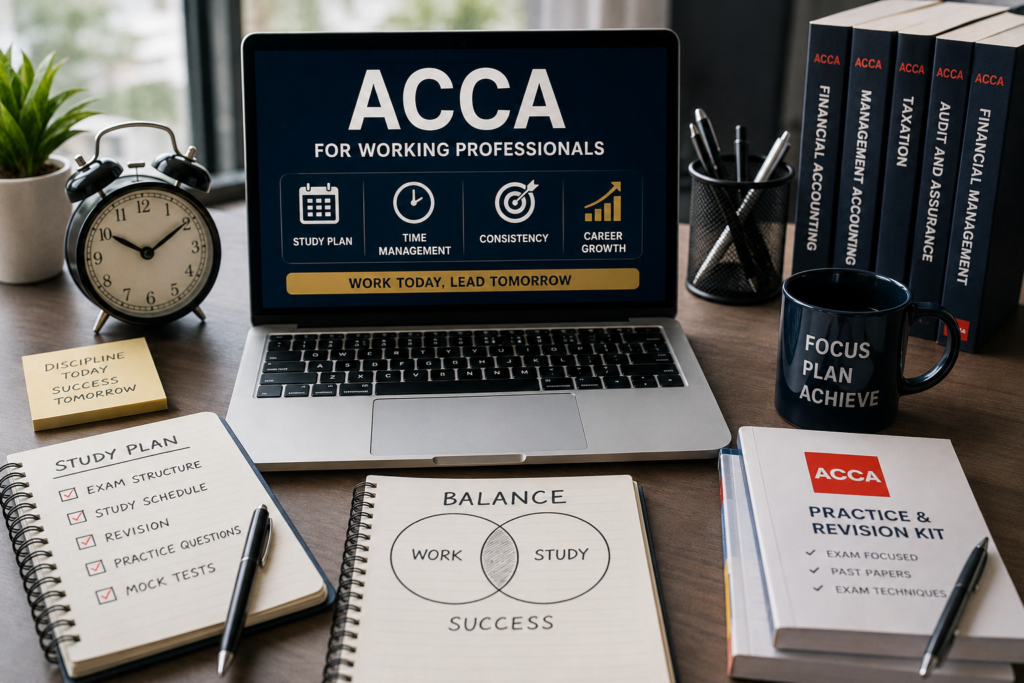
Block it on your calendar. Doesn’t matter if it’s forty minutes or ninety, what matters is it happens most days. An hour a night, four or five nights a week, will take you further than one exhausted six-hour Sunday session where you’re barely absorbing anything by hour three.
Practice Questions Beat Rereading Your Notes, Every Time
This one trips up a lot of working professionals. When you’re tired after work, rereading notes feels productive because it’s easy. But it barely sticks. What actually prepares you is grinding through past papers and mock exams, because that’s active recall, and that’s exactly what you’ll need months later sitting in the actual exam trying to piece together concepts you studied in scattered fragments.
Bring Your Employer into the Loop
Don’t keep your ACCA plans a secret from your manager. A surprising number of accounting and finance firms have some form of study support, whether that’s paid study leave before exams or a lighter workload during exam weeks. You won’t know what’s available unless you actually ask. And most managers I’ve come across respect someone who’s clearly investing in their own growth rather than seeing it as a distraction from work.
The Isolation Is Real, Plan for It Too
ACCA can stretch across several years when you’re doing it alongside a job, and that length of time gets lonely in a way people don’t warn you about. Your friends are out on weekends; you’re home going through financial reporting standards for the third time. Find an online ACCA community, grab a study partner, or team up with a colleague also pursuing it. Having someone to vent to on a bad week matters more than people expect.
What This Actually Does for Your Career
Beyond the discipline it builds, ACCA carries genuine weight because it’s recognized in over 180 countries. If international roles or global clients are anywhere on your radar, that matters. Within finance and accounting circles, it signals real depth across financial reporting, audit, tax, and strategic decision making, not just technical accounting skills.
For working professionals, it’s often what pushes you out of execution heavy roles and into ones where you’re actually making decisions. Controller roles, finance manager positions, eventually CFO track opportunities, these tend to open up more readily once ACCA is behind your name, because it tells an employer you’ve got both the technical range and the grit to finish something hard while holding down a full-time job.
It also gives you real leverage when you’re negotiating a raise or considering a switch, since employers know this qualification isn’t something people casually breeze through, especially while working.
Some Sessions Just Won’t Go Your Way
You’ll walk into some exam sessions completely ready. Others, work will eat your study time and you’ll either go in underprepared or defer entirely. That’s completely normal and happens to nearly everyone doing this alongside a job. The people who actually finish ACCA aren’t the ones who never stumbled. They’re the ones who didn’t let one rough session talk them into quitting altogether.
At the core of it, managing ACCA with a full-time job is less about willpower and more about quiet, boring consistency. Plan around your actual life, protect whatever study time you carve out, and trust that slow progress still counts as progress. Plenty of working professionals have made it through this exact path before you, and come out the other side with a qualification that genuinely reshapes what’s possible in their career.
Frequently Asked Questions
Most people take somewhere between 3 to 4 years, depending on how many sessions a year they sit and how consistently they can study around work.
One paper a session tends to work best for most people. Piling on more without enough prep time often leads to burnout or failed attempts, which costs you more time overall.
Yes, quite a bit. It’s globally recognized and often becomes the deciding factor for moves into senior finance and leadership roles that experience alone doesn’t always unlock.
Yes, easily. That’s actually one of ACCA’s biggest strengths for working professionals. You can sit fewer papers, or skip a session entirely, and pick back up later without losing what you’ve already cleared.
Definitely still worth it. It demonstrates depth across financial reporting, audit, and strategic finance that a lot of local qualifications simply don’t cover in the same way, even for domestic roles.