

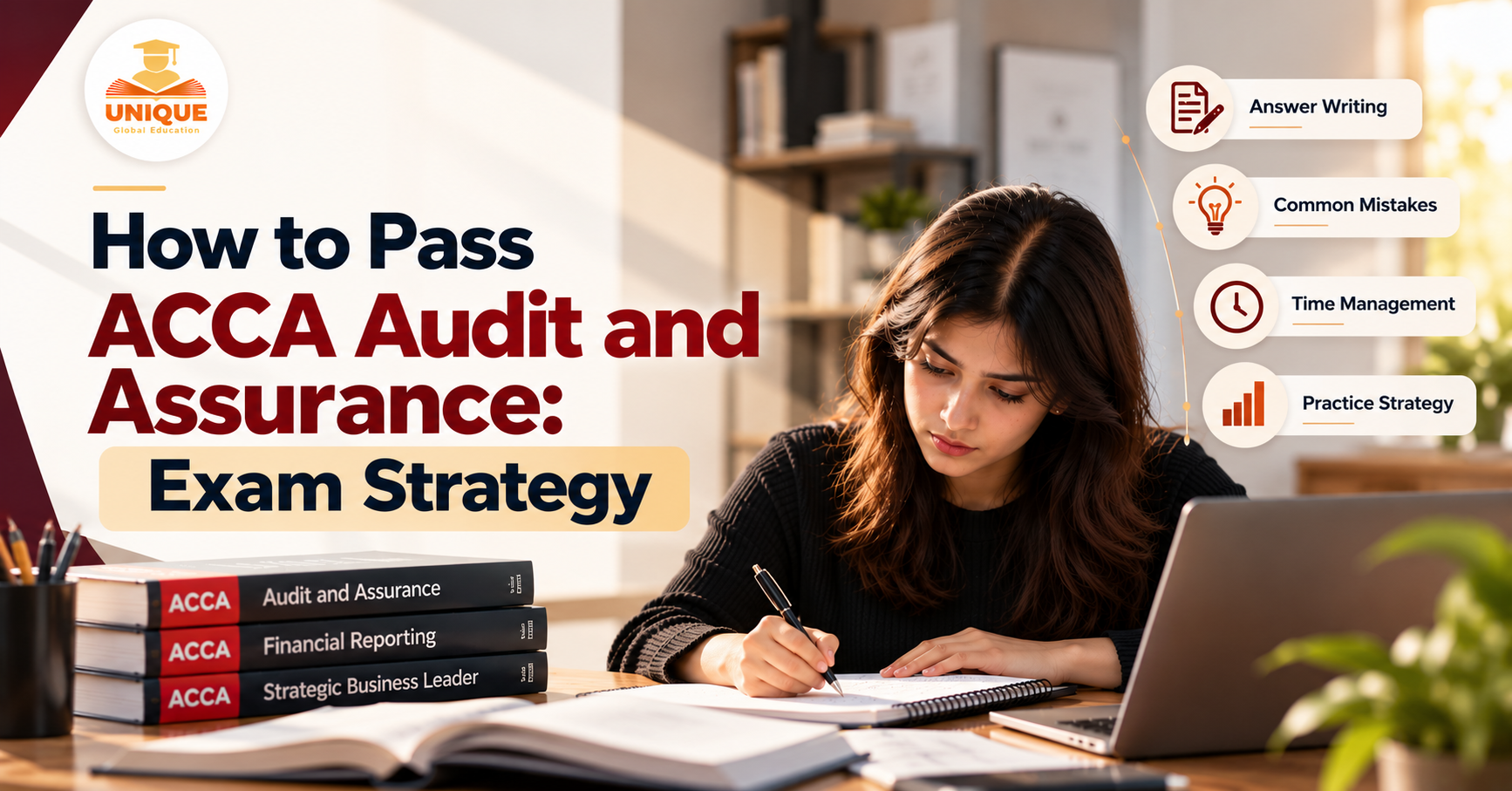
Knowing how to pass ACCA Audit and Assurance requires more than memorising audit theory. AA is an application-heavy paper, and ACCA’s examiner guidance repeatedly shows that candidates lose marks when they do not practise enough questions or fail to apply their knowledge directly to the scenario.
This guide focuses on the answer-writing mistakes that cost students marks and the practice strategy that can help improve exam performance. The official exam-technique points are based on ACCA examiner guidance, while the practical study recommendations are explained separately.
Table of Contents
How to Pass ACCA Audit and Assurance: Understand the Exam Format
AA is a computer-based exam, and all questions are compulsory. Section A has three objective test cases, each with five questions, worth 30 marks in total. Section B has one constructed response question worth 30 marks and two worth 20 marks each. ACCA also points out that CBE candidates don’t always get the same questions, so you can’t plan around a “predicted” topic. The report works to 1.8 minutes per mark, which means a 5-mark requirement deserves about 9 minutes.
Mistake 1: answering a different question
The report gives a clean example. A requirement asked for three purposes of documenting audit work. A sizeable minority wrote about what audit documents are, or about flowcharts for documenting controls. They saw the word “documenting” and wrote everything they knew about it. Before you type anything, underline the verb and the key word. Ask yourself what exactly is being asked: why, what, how or which.
Mistake 2: vague, short points
ACCA marks many points at only half a mark because they are too brief. Repeating the requirement back earns nothing. In the report, “to decide whether to test controls” got half a mark, and a full mark needed the next step: if the controls are well designed, substantive testing can be reduced. For “explain” requirements, one line is never enough. Finish the thought.
Mistake 3: copying the scenario instead of spotting the issue
For risks and control deficiencies, half a mark goes to identifying it and another half to explaining it. Pasting a fact from the scenario doesn’t count as identifying. Take the example of goods being checked only against the supplier’s delivery note. The deficiency is that quality and the purchase order aren’t checked, not the delivery note check itself.
Explanations need the same care. “This could lead to fraud or error” fits every deficiency, so it scores nothing. For risks, name the area of the financial statements and the problem, such as PPE understated or depreciation expense understated, or name the assertion or the type of risk. ACCA also says you can’t hedge by writing both overstated and understated.
Looking for ACCA Classes in India? Visit Unique Global Education for course details and guidance.
Mistake 4: weak recommendations and tests of controls
Recommendations should be actions, not goals. A line starting “ensure that” rarely earns credit, and just flipping the deficiency into a sentence only earns half a mark. If a clerk doesn’t chase overdue debts, say how, for example by reviewing the aged receivables listing each month.
Tests of controls need detail too. A test that starts with “check” tells the examiner little. Say which document you inspect and what you are looking for. ACCA also notes that inspection and enquiry give stronger evidence than observation, and that tests of controls are what the auditor does, not advice for management.
Mistake 5: rote-learnt substantive procedures
Many candidates produce the same list of tests for every question. The report calls this an approach that generates few marks. Good substantive procedures name the source document and the purpose. “Agree to bank statements” is weak. “Agree net pay from the payroll records to the bank ledger and statements” is much better.
Watch these traps from the report. Mixing up tests of controls and substantive procedures. Writing payables tests when the requirement is about purchases. Using purchase invoices for cut-off instead of goods received notes. Doing analytical review without investigating the fluctuations, which caps the mark at half. And adding written representations or bonus tests that the scenario never called for.
Mistake 6: giving management advice as the auditor’s response
When a risk asks for the auditor’s response, say what the audit team will do. Recommending that the company hire a new financial controller is a management response and scores nothing. “Increase professional skepticism” on its own earned only half a mark in the report, because it doesn’t produce evidence. “Discuss with management” with no detail earns nothing. Say what you will ask for and what document you will look at.
Mistake 7: skipping easy marks
Ratios in a risk question carry half a mark per ratio per year, and only for the correct final answer. Workings earn nothing and a calculation without a result earns nothing, so six ratios should take just over five minutes. Subsequent events is core syllabus too. Start with IAS 10, decide if the event is adjusting, calculate materiality using the right figure, then give the procedures. ACCA also warns against assuming the reporting question will always be about the auditor’s report.
How to Pass ACCA Audit and Assurance: Final Practice Strategy that fits the report
Practise by topic first and mixed papers later. For controls and deficiencies, the report points to published sample exams such as Harper Co and Granstan Co. For audit risk, it suggests Pimento Co and Musitastic Co. For substantive procedures, it names Everest Co and Tennessee & Co.
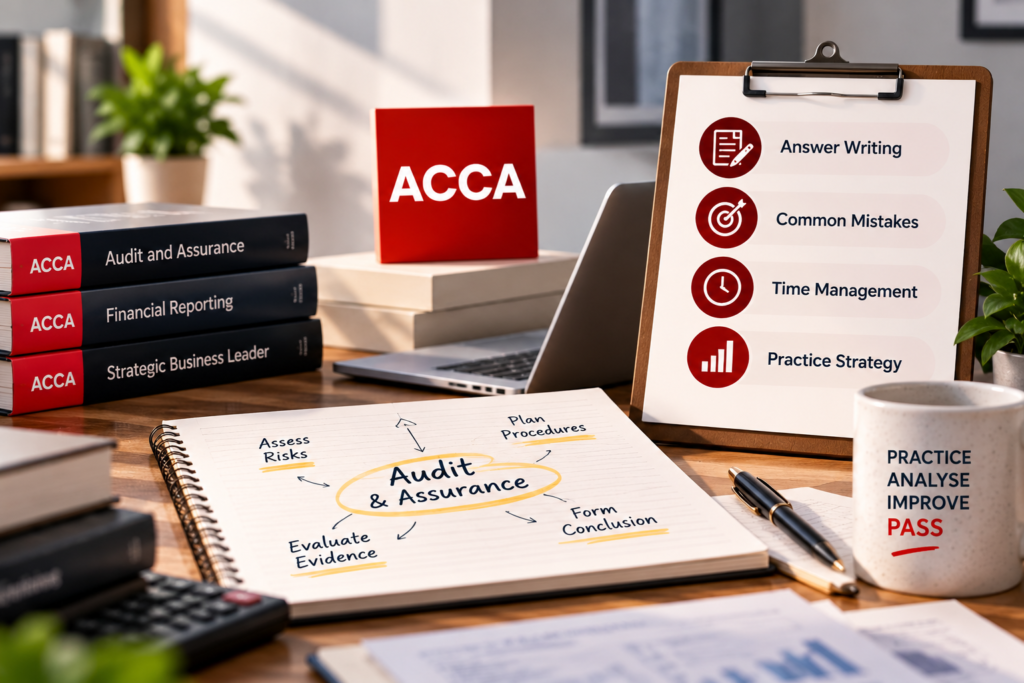
Write every answer to the mark. Count points against the marks available, because a 5-mark requirement wants five well-explained tests. Time yourself at 1.8 minutes per mark, then mark yourself against ACCA’s examiner’s report, which shows exactly where half marks are lost. On the real exam, ACCA recommends reading the scenario fully first and using the highlight function to spot risks, then re-reading as you draft.
How to Pass ACCA Audit and Assurance: FAQs
There are two sections and every question is compulsory. Section A has three objective test cases of five questions each, worth 30 marks. Section B has one 30 mark constructed response question and two 20-mark questions.
ACCA’s report uses 1.8 minutes per mark, so a 5-mark requirement should take about 9 minutes.
No. ACCA awards half a mark per correct ratio per year, and workings or formulas earn nothing. Write the final answer for every ratio.
Not on its own. ACCA’s report says it earned only half a mark because it doesn’t help gather evidence. Add the specific extra procedures you would perform.
ACCA publishes sample exams on its Practice Platform, and each examiner’s report names good questions to Practise by topic, so use the report as your practice list.