


There is a moment every CFA candidate experiences somewhere around their second month of studying. You are deep in time value of money problems, your notebook has more scribbles than a kindergarten art project, and you suddenly realize that the calculator sitting next to you is either going to be your best friend for the next year or the reason you lose five precious minutes on exam day fumbling through functions you never properly learned.
The calculator is not a small decision. I know it sounds like one. But talk to anyone who has sat for the CFA exam and they will tell you the same thing. Knowing your calculator the way you know your own handwriting is the difference between confidence and panic when the clock is running.
So let us get into everything you need to know for 2026.
Table of Contents
What the CFA Institute Actually Allows
The CFA Institute permits only two calculators in the exam room. No exceptions, no workarounds, no bringing a backup from a different brand.
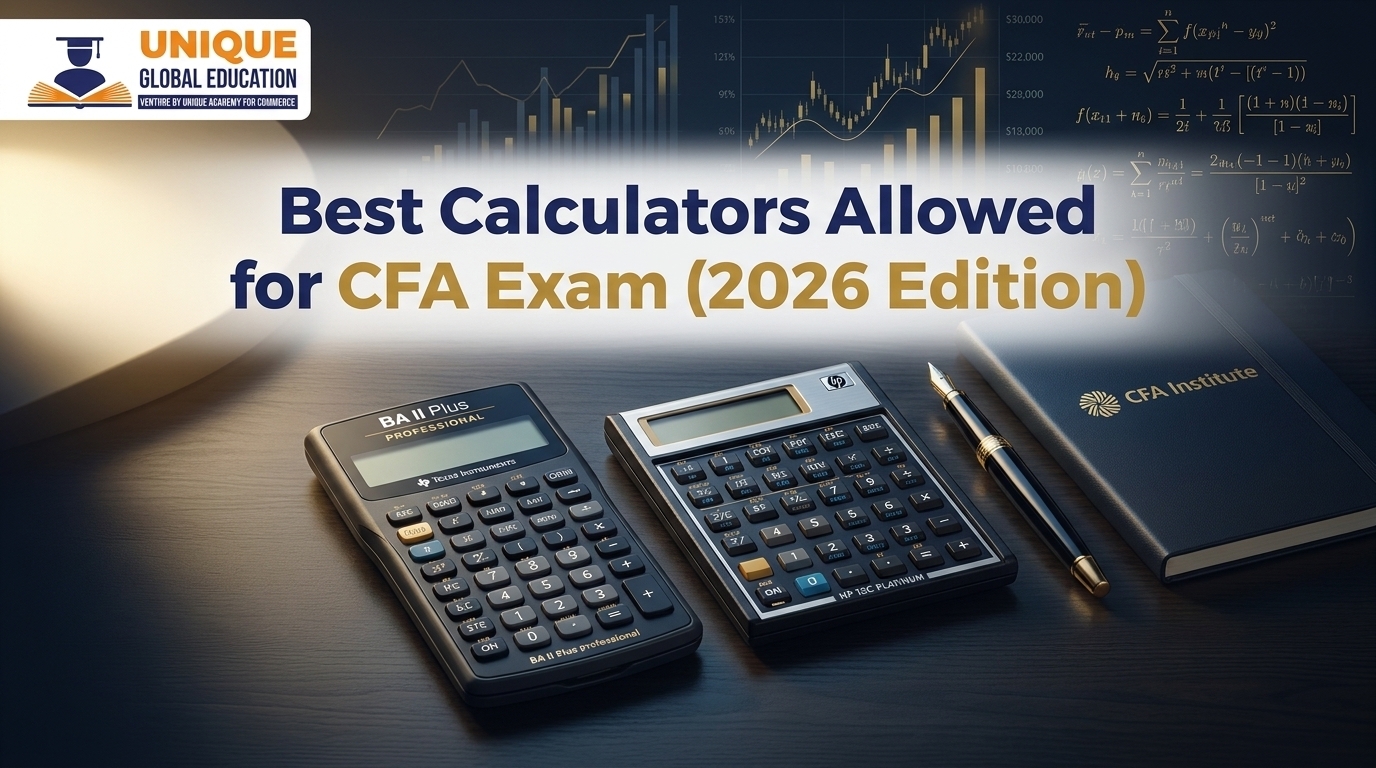
Those two are the Texas Instruments BA II Plus (including the Professional version) and the Hewlett Packard HP 12C (including the Platinum edition).
That is the complete list. If you walk in with anything else, including a scientific calculator that costs a fraction of either of these, it gets confiscated and you sit the exam without one. So please, do not experiment with this rule.
Best Calculators Allowed for CFA Exam
Texas Instruments BA II Plus: The One Most Candidates Choose
Walk into any CFA study group anywhere in the world and look around the table. Odds are strong that eight out of ten people have the BA II Plus sitting in front of them. There is a reason for that, and it is not just herd mentality.
The BA II Plus works on a straightforward algebraic logic that feels natural to anyone who grew up using a standard calculator. You input numbers in the order that makes intuitive sense. For most people coming from a non-finance background or transitioning from university, this is genuinely easier to get comfortable with than the alternative.

For the CFA curriculum specifically, the BA II Plus handles everything you need with real efficiency. Time value of money calculations, cash flow analysis, NPV, IRR, amortization schedules, depreciation, bond pricing, statistics. The dedicated TVM worksheet alone saves enormous time once you know how to use it properly. You punch in your variables, solve for the unknown, and move on. Clean and fast.
The standard BA II Plus costs somewhere between $30 and $45 depending on where you buy it. The Professional version runs a little higher, usually around $50 to $60, and adds a few extras like more cash flow storage capacity and a slightly better display. For most candidates the standard version is completely sufficient. The Professional version is a nice upgrade if you find the price difference easy to absorb, but nobody is failing the CFA because they chose the standard model.
One thing worth knowing early: the BA II Plus comes from the factory set to process payments at the end of a period, which is the standard convention, but it is also set to 12 payments per year by default. Depending on the problem you are solving, leaving it on that setting can give you wrong answers. Change it to one payment per year when you first open the box and make it a habit to verify your settings before starting any calculation. This catches more candidates off guard than almost anything else in the quantitative sections.
Hewlett Packard HP 12C: The One With a Loyal Following
The HP 12C has been around since 1981. That is not a typo. Finance professionals in banking, real estate, and investment management have been using this calculator for over four decades and many of them would not trade it for anything.
What makes the HP 12C different is its operating logic. It uses Reverse Polish Notation, which means instead of entering an equation the way you would write it, you enter the numbers first and then the operation. So instead of typing 5 plus 3 and pressing equals, you type 5, then 3, then the plus key. That description makes it sound confusing, and honestly for the first week it probably will be. But candidates who push through that learning curve often find that RPN actually speeds up complex calculations because you never have to worry about brackets or order of operations.
The HP 12C also has a physical build quality that feels noticeably different from the BA II Plus. Heavier, more solid, with keys that have a satisfying tactile response. For candidates who spend hours a day on practice problems, that physical experience is not nothing.
The Platinum edition adds a few expanded functions and slightly faster processing. For the CFA exam both the original and Platinum are permitted.
The honest advice here is this: if you have never used RPN before and you are starting your CFA preparation from scratch, the BA II Plus will get you exam-ready faster. The HP 12C rewards candidates who either already know RPN or who have enough study time to invest in learning it properly without it cutting into their curriculum coverage.
Which One Should You Actually Buy
For most candidates, especially first-timers and those who are studying while working full-time, the BA II Plus is the smarter starting point. The learning curve is shorter, the resources available online are more abundant, and the exam-focused tutorials from Kaplan Schweser, CFA Institute itself, and countless YouTube channels are almost all built around the BA II Plus.
If you are a finance professional who has been using the HP 12C for years already, stick with it. Switching calculators mid-preparation to match what everyone else is using makes no sense when you already have fluency with one of the permitted options.
If you genuinely enjoy the idea of learning RPN and you are starting early enough that you have time to build real comfort with it before exam day, the HP 12C is a worthy choice and you will join a community of professionals who swear by it for life.
Buy one, commit to it completely, and practice with it every single day. The worst thing a candidate can do is spend three months with one calculator and then switch because they heard the other one was better. Familiarity on exam day is worth more than any marginal feature difference between the two.
A Few Things That Catch People Out on Exam Day
Bring fresh batteries and actually replace them before exam day rather than hoping they last. A dying calculator mid-exam is a level of stress nobody needs.
Get More Details CFA Classes Online and Face To Face Batches
Candidates are allowed to bring more than one calculator into the exam room. Bringing both permitted models as backup is completely within the rules and worth considering, particularly if you are the type of person who sleeps better knowing they have a backup plan.
Clear your calculator memory before the exam. Some testing centers ask you to demonstrate that memory has been cleared before you are seated.
Practice under timed conditions regularly. Knowing where every function lives without having to think about it is the actual goal. Speed on calculations creates space for thinking on the harder conceptual questions.
7 FAQs Worth Reading Before Exam Day
Yes. You are allowed to bring multiple calculators as long as each one is from the approved list. Having a backup is smart and completely within the rules.
For most candidates the standard version handles everything the exam requires. The Professional version offers minor upgrades that will not meaningfully affect your score.
Absolutely not. Electronic devices other than the two approved physical calculators are prohibited in the exam room entirely.
Both the original and the Platinum edition are permitted. The Platinum has slightly expanded functions but both are fully capable for CFA exam purposes.
Most candidates feel genuinely confident with it after two to three weeks of daily practice. Full fluency, the kind where you never hesitate, usually comes around the four to six week mark.
If you brought a second approved calculator you can switch to it. This is the most practical reason to bring a backup regardless of how reliable your primary calculator has been during preparation.
A used calculator works perfectly well as long as the keys are all responsive and the battery is fresh. Many candidates buy secondhand and have no issues. Just test it thoroughly before exam day and do not leave battery replacement to the last minute.
Your calculator is the one tool you will use on every single quantitative question in the exam. Treat learning it as seriously as you treat learning the curriculum itself. The candidates who do that walk out of the exam room calmer than everyone else, and that calm is worth every hour of practice.