


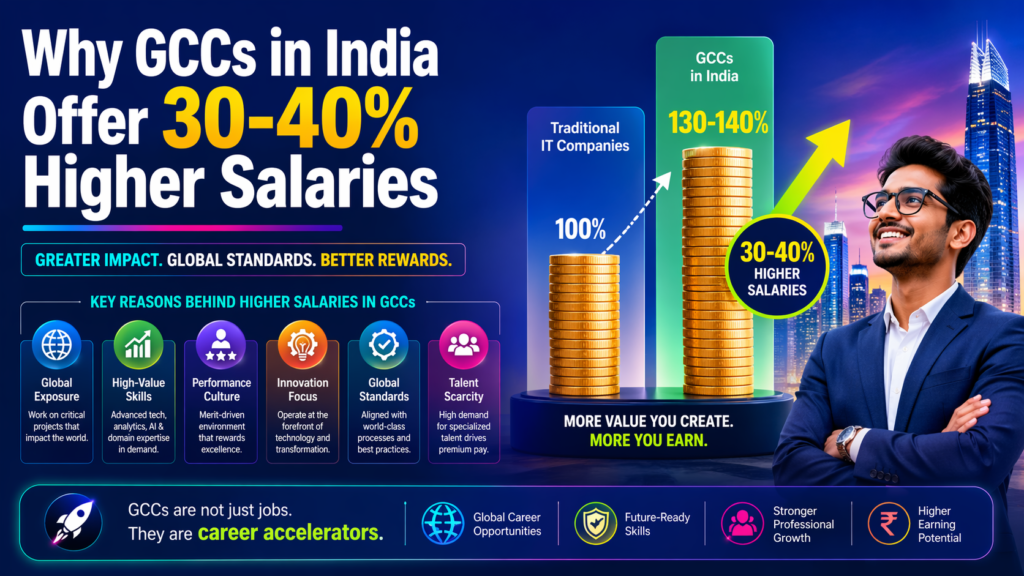
If you are working in finance right now, or you are trying to break into a GCC role, and you have not looked seriously at the US CMA yet, you are probably leaving somewhere between 4 and 8 lakhs on the table every single year. Not maybe. Not theoretically. Actually, leaving it on the table while someone else picks it up.
I know that sounds dramatic. But stick with me for a few minutes because this is worth understanding properly.
Table of Contents
So What Is Happening in the GCC World Right Now?
India has over 1,700 Global Capability Centers operating in 2026. Bangalore, Hyderabad, Pune, Chennai, Gurugram. You know the names. These are not the sleepy back offices they used to be 10 years ago where people were just processing invoices and reconciling accounts. Those days are gone.
What is happening now is that the parent companies, sitting in New York, Chicago, San Francisco, are pushing real finance work into India. FP&A. Cost management. Business partnering. Budgeting cycles that feed directly into board-level decisions. The Indian GCC finance team is now talking to the US CFO, not just the local admin.
And that is where the problem shows up. Because you cannot do that work in a vacuum. You need to think the way American finance teams think. You need to speak their language, not just English, but the actual conceptual language of management accounting the way it is practiced in the US.
This Is Exactly Where the US CMA Comes In
The CMA exam from the Institute of Management Accountants is not a broad everything qualification. It is specifically and deliberately built around management accounting and financial decision making. Variance analysis. Standard costing. Performance measurement. CVP analysis. Capital budgeting. Scenario planning. Risk management.
You read that list and then you look at a GCC FP&A job description and you realize they are basically the same document. That alignment is not a coincidence. That is why GCC hiring managers light up when they see US CMA on a resume.
One finance director at a large BFSI GCC in Bangalore said something to me that I have not forgotten. He said when we hire a US CMA we skip about three months of reorientation. They come in already calibrated. That three months of saved reorientation has a real rupee value to the company. So they pay for it upfront in the salary itself.
Why the Premium Is 30 to 40 Percent and Not 10
Because the supply is genuinely small. This exam is hard. Not hard in a memorize everything way but hard in a you actually have to think and apply judgment way. A lot of people start preparing and not everyone finishes. The pass rates are not embarrassing but they are not a free pass either.
So you have this situation where GCC finance hiring is growing every quarter and the number of people who actually hold this specific certification in India is still relatively modest. When demand runs ahead of supply by that kind of margin, salaries move. That is just what happens.
And the companies competing for these candidates are multinationals with global salary benchmarks. They are not negotiating the way a local firm might. They have a band, they know the premium is real, and they pay it because the alternative is leaving a critical role unfilled or hiring someone they have to spend months retraining.
The Credibility Factor Nobody Talks About Enough
There is something beyond skills happening here too. When an Indian finance professional with a US CMA gets on a call with the US-based controller or CFO, there is an instant credibility established. The American side of the table recognizes the credential. They know what it took to get it. They know the curriculum maps to the work.
That credibility translates into faster career progression, more visibility, and eventually more compensation. The salary premium you see at hire is just the starting point. The trajectory over 5 to 10 years for a US CMA holder in a GCC environment tends to pull significantly ahead of peers who do not have it.
Which Roles Actually See This Premium
To be fair to you, this premium does not apply equally everywhere. Where it is strongest is in FP&A analyst and manager roles, cost accounting and cost management positions, finance business partner roles, and management reporting functions that feed into global leadership.
Get Details for US CMA Online & Face to Face Batches
In pure statutory accounting or Indian compliance-heavy roles, the premium is softer because those roles lean more on knowledge of Indian standards and regulations where the US CMA curriculum does not add as much. But if you are anywhere near the strategic finance world inside a GCC, the certification is as close to a guaranteed salary bump as anything in this profession right now.
Will This Premium Still Be There in Three Years
Yes. Here is the honest answer. GCCs are not pulling back from India. The opposite is happening. More work is coming here, higher value work, because the talent quality has proven itself and the economics still make sense. The demand side of this equation is not slowing down.
Will more people pursue the US CMA over the next few years and gradually bring the premium down a little? Probably yes at the margins. But the structural reasons for the premium, the curriculum fit, the US recognition, the supply gap, those do not disappear quickly.
If you are 26 or 32 or even 38 and you are in finance and you have been thinking about this but not acting on it, 2026 is not a bad time to stop thinking and start doing.
FREQUENTLY ASKED QUESTIONS
For GCC roles where your work connects to a US-based finance leadership team, yes the US CMA from IMA carries more weight. The Indian CMA is genuinely valuable for roles that involve Indian statutory cost accounting and compliance. But the moment your job description includes FP&A, business partnering, or management reporting in a global context, the US CMA speaks the language your stakeholders actually use. Both credentials have their place but they solve different problems.
Most working professionals take somewhere between 12 and 18 months to finish both parts. If you are disciplined and not juggling a crazy workload, some people do it in 9 to 10 months. Each part needs roughly 150 hours of genuine study, not passive reading but active problem solving. It is an investment of time that you will feel while you are doing it. Most people who have cleared it say the same thing looking back: harder than they expected, worth more than they expected.
Freshers who clear the US CMA do see a bump, usually in the 15 to 20 percent range at entry level compared to non-certified peers joining similar roles. The bigger 30 to 40 percent premium really shows up once you have 3 to 6 years of experience and you are moving into manager-level positions. The certification does not just change your starting salary, it changes how fast you move through the levels. That compounding effect over a career is honestly the bigger story.
BFSI GCCs are at the top of this list. Goldman Sachs, Citi, American Express, Barclays, HSBC, JP Morgan. These organizations have deeply embedded management accounting cultures and they know the IMA credential well. Right behind them are large US technology and industrial GCCs like Microsoft, Honeywell, Caterpillar, and similar firms. The common thread is that their finance teams report into US leadership and are doing genuinely strategic work rather than transactional processing.
You need two continuous years in management accounting or financial management to officially become a certified member and use the designation after your name. The good news is you can sit the exams and clear them before completing the experience requirement. Many people in India do exactly that. They pass both parts, then accumulate the experience, and officially become CMAs within the required seven-year window. So you do not need the experience to start, just to finish.
Very much so. The IMA credential has strong recognition in the United States obviously, but also in the Middle East, Singapore, Australia, and other markets where multinationals operate. If your 5 or 10 year plan includes working abroad or transitioning into a global finance role from India, the CMA travels with you in a way that country-specific qualifications cannot. A number of GCC finance professionals have used it specifically as a bridge toward US assignments or international postings.
All in, you are looking at somewhere between Rs 1.5 lakh and Rs 2.5 lakh depending on the coaching you choose and the IMA membership category. The IMA does offer lower membership rates for candidates from developing economies which helps. When you compare that investment against a salary premium of Rs 4 to 8 lakh per year at the manager level, you typically recover the full cost within your first year in the premium role. There are not many certifications in the finance world that offer that kind of return that quickly.