

Table of Contents
What Is Risk Management? Career Scope After FRM
A few years ago, a friend who worked at a mid-sized bank told me something that stuck. He said the risk team was the only department nobody wanted to listen to until something went wrong, and then suddenly everyone wanted to know why they had not spoken up sooner. Those dynamic captures risk management better than any textbook definition.
It is the function that exists to say, here is what could go wrong, here is how bad it could get, and here is what we should do before it actually happens. Every business faces this problem. A bank lends money and some borrowers stop repaying. A company earns in dollars but its costs are in rupees and the exchange rate moves against it overnight.
An investment fund takes a position and the market goes the other way. Risk management is the professional discipline built to handle all of this, and the FRM, which stands for Financial Risk Manager, is the certification that defines who is qualified to do it seriously.
What the Work Actually Looks Like
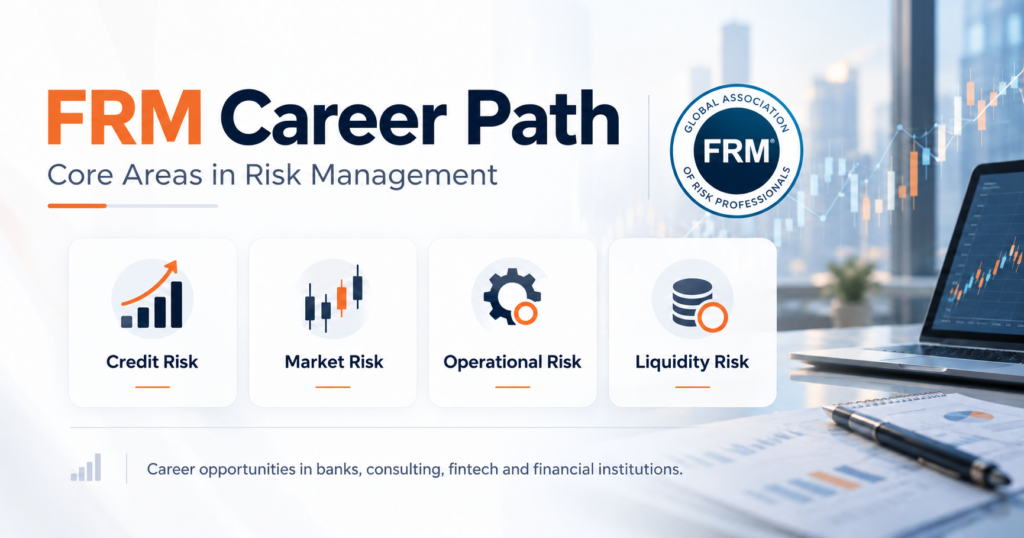
Risk management inside a large institution is not one job. It is several, each focused on a different category of problem. Credit risk teams assess whether borrowers are likely to honour their obligations or default. Market risk teams measure how much the institution stands to lose if interest rates move, currencies shift, or equity prices fall. Operational risk teams look at the internal processes and human decisions that create exposure. Liquidity risk professionals focus on whether the institution can meet its obligations without being forced to sell assets at exactly the wrong moment.
At senior levels the work expands into stress testing, where you model extreme scenarios and ask what happens if multiple things go wrong at once. Regulators around the world require large banks and financial firms to run these exercises regularly and report the results. That regulatory layer has created a steady, permanent demand for qualified risk professionals that holds up even when markets are quiet.
Get All Updates Regarding The FRM
What the FRM Is and Why It Matters
The FRM designation comes from GARP, the Global Association of Risk Professionals, based in the United States. It is the most widely recognised qualification in financial risk management in the world.
Part 1 builds the foundation: quantitative methods, financial markets, valuation tools, and the core mechanics of risk measurement. Part 2 goes deeper into market risk, credit risk, operational risk, liquidity risk, and how risk management works inside investment firms. You need to pass both parts and show two years of relevant work experience before earning the full designation. Many people clear Part 1 during graduation and complete Part 2 a year or two into their first job. Employers who actively look for FRM are spread across New York, London, Hong Kong, Singapore, Frankfurt, Dubai, and increasingly Mumbai.
Why Risk management Makes Sense for a Commerce Background
Risk management almost never comes up in commerce classrooms, which is genuinely strange because the fit is excellent. The economics, financial accounting, and business studies you spent three years on give you an instinctive feel for how institutions function, how money moves through a system, and where the vulnerabilities tend to appear. That is the exact mental model risk professionals develop through years of experience.
The quantitative content in FRM Part 1 covers statistics and probability, taught within the curriculum without assuming prior knowledge. Commerce students who were solid in economics and accounts consistently find the conceptual side clicks naturally. The maths requires real effort but it is not the wall most students assume before they actually sit down and work through it.
Where Risk management Career Actually Takes You
Banks are the biggest employers of risk professionals globally, with roles at every level from entry analyst upward. Institutions like HSBC, Citibank, Standard Chartered, and Barclays run dedicated credit, market, and operational risk functions that hire continuously. Asset management firms need risk managers to monitor portfolio exposures. Insurance companies employ risk teams whose work overlaps significantly with financial risk. Consulting firms including McKinsey, BCG, and Oliver Wyman have dedicated risk practices and hire FRM professionals to advise financial institutions on their frameworks.
Central banks and regulators are an underrated option. The Financial Conduct Authority in the UK, the Federal Reserve in the United States, and equivalents across Singapore and Hong Kong employ risk professionals to supervise institutions from the outside. These roles are stable, intellectually serious, and offer something rare: the experience of seeing the entire financial system from the oversight side rather than from within one institution.
Fintech is the newest employer of risk talent and growing fast. Digital lending platforms, payment companies, and crypto firms have scaled quickly enough that their risk problems have outpaced their ability to manage them. FRM professionals with some familiarity with data tools are finding interesting and well-paid work here.
FAQs
Not in the way most people worry about. The quantitative content in Part 1 covers statistics and probability, and GARP teaches it within the curriculum rather than assuming prior knowledge. Most commerce students who were solid in economics and accounts find the conceptual sections feel familiar. The maths requires real effort but it is not a locked door. The students who struggle are usually those who assume it will be too hard and never give it a genuine attempt.
Yes, and it is a smart move. Sitting for Part 1 in your second or final year means you enter the job market with something concrete already done. Employers notice it because it signals you were thinking about your career before graduation rather than after. GARP runs exam windows twice a year, so with some planning you can fit it around your academic schedule without too much disruption.
Banking is the biggest by a significant margin, with risk functions at every level from analyst upward. Asset management, insurance, management consulting, and financial regulation are the other main sectors. Fintech has quietly become a real employer over the last few years, particularly in digital lending and payments where credit and fraud risk have moved from back-office concerns to core business problems that need experienced people working on them full time.
They cover different ground and work well together rather than competing. CFA is the stronger credential if you want investment management, equity research, or portfolio analysis. FRM is right if the risk and institutional side interests you more. If you are genuinely unsure, pay attention to which problem feels more interesting to you: analysing whether a company is a good investment, or figuring out whether an institution is carrying more risk than it should be.
Entry-level risk analyst roles at banks and consulting firms in India typically start between six and twelve lakhs per annum depending on the institution and city. That moves up meaningfully with three to five years of experience and the full FRM in hand. Internationally, risk roles at global banks in London, Singapore, or Hong Kong reflect both the technical depth of the work and its regulatory importance. Senior risk professionals at large institutions tend to be among the better-paid people in financial services, and the trajectory to get there is more stable than most finance careers.