


Most people comparing CFA Level 1 Self-Study vs Coaching ask, “Should I join a class?” only after they have already registered and paid. It works better the other way round. The exam fee is the bigger decision, and the study route is what protects it. Everything below about the exam, the fees and the study tools comes from CFA Institute’s own pages. The judgement calls are mine, and I say so.
Table of Contents
What CFA Institute Includes in Your Registration
Your registration fee includes the Learning Ecosystem, CFA Institute’s digital study platform. Access to it begins after you register. It holds the full curriculum, practice questions, official mock exams, flashcards, study tools and the Practical Skills Modules. You can buy a print curriculum after registering.
There is also an optional paid Practice Pack, which adds five more mock exams, one Prometric mock exam that mimics exam day, and 1,000 extra questions for Level I. One thing students shouldn’t overlook is the Practical Skills Module (PSM). CFA Institute requires candidates to complete at least one PSM at each level to receive their exam result.
It generally takes 10–20 hours, so include it in your preparation schedule.CFA Level I exam registration starts at USD 1,140 during the early-registration period, roughly ₹1,02,600 at an illustrative exchange rate of ₹90 per dollar, excluding applicable taxes.
CFA Institute says completing all three levels costs USD 3,520 to 4,570 in exam fees, depending on early or standard registration, which is about ₹3.17 lakh to ₹4.11 lakh at the same rate. Update the rate before you budget. The point is that a complete self-study route is already in the box.
CFA Level 1 Exam Format and Topic Weights
Level I has 180 multiple-choice questions in two 135-minute sessions of 90 questions each. Each question has three answer choices, all questions carry equal weight and there is no penalty for a wrong answer. CFA Institute suggests about 90 seconds per question, and says successful candidates report spending over 300 hours per level.
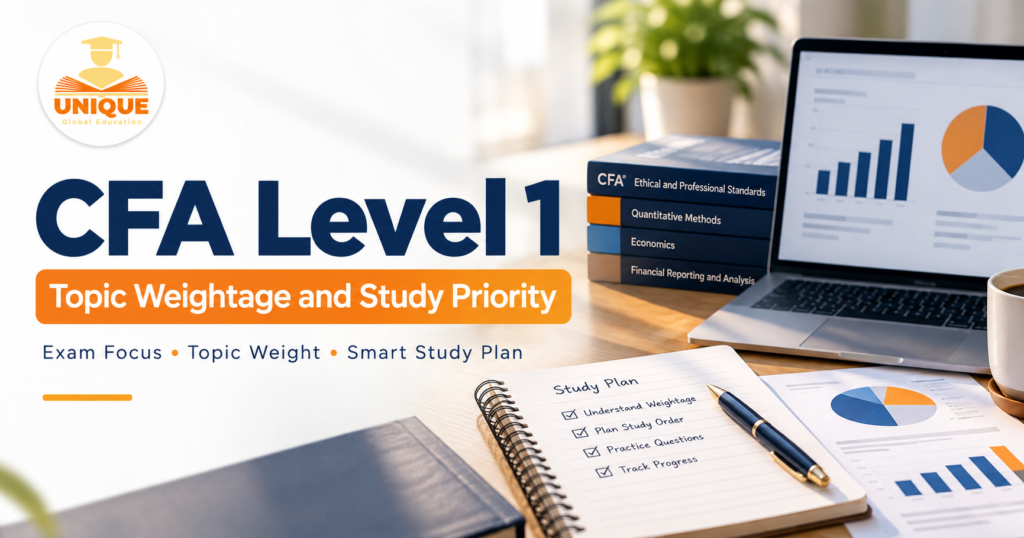
Topic weights also matter for this decision. CFA Institute publishes separate tables for 2026 and 2027. In the 2027 table, Quantitative Methods rises to 11 to 14 percent, from 6 to 9 percent in 2026, while Ethical and Professional Standards falls to 10 to 15 percent from 15 to 20. Check which table applies to your exam window.
When Self-Study Makes Sense for CFA Level 1
I would back self-study for someone who already works with financial statements or statistics, can protect roughly 300 hours (about 12 hours a week over six months, by my arithmetic), and finishes things without being chased. In that case the Learning Ecosystem does most of what a class would do.
Use it properly. CFA Institute says its platform is the only way to officially track your practice questions and your proficiency in each topic. Its study tips also say to leave time after every mock exam to understand why you missed each question. Reviewing mistakes is where self-studiers either win or fool themselves.
Visit Unique Global Education for more CFA Related Update
When CFA Level 1 Coaching Is Worth the Cost
Coaching helps most when your gap is specific or your habits are the problem. If probability and statistics feel shaky, the heavier Quantitative Methods weight in 2027 is a real risk. If you start strongly and fade, a fixed class schedule does what willpower can’t. And if you tend to do only the topics you like, a teacher who sets the order removes that temptation.
Coaching can’t sit the exam for you or replace 300 hours, though. CFA Institute maintains a list of Prep Providers who agree to follow its guidelines and standards, and providers that have partnered with it for at least five years now carry the Approved Prep Provider label.
Start with that list and ask each provider for a written quote and a sample class. If a provider isn’t on the list, it isn’t a CFA Institute Prep Provider. Check what it adds to the platform included with your registration. If the answer is mainly the same questions in a new wrapper, keep your money.
The Cost of Registering Before You’re Ready
CFA Institute states that exam fees are non-refundable, non-deferrable and non-transferable if you miss your appointment. If an appointment is available, moving your appointment within the same exam window costs USD 250, about ₹22,500, and the deadline CFA Institute sets still applies.
You can also sit the exam at most twice in a calendar year, and not in consecutive windows or in windows within six months of each other. So, a failed attempt can cost you more than the fee. It can cost you the next window. One change matters for 2027.
CFA Institute no longer offers paid deferrals for exams from February 2027 onward. Candidates registered for a 2026 exam could buy a USD 449 deferral before the applicable deadline. From February 2027, if you don’t sit your scheduled exam, you forfeit your registration fee and must re-register at the rate available for a later exam.
Emergency deferrals still exist for qualifying cases, such as a life-threatening illness or the death of an immediate family member. Approved emergency deferrals carry a USD 100 processing fee, except where Prometric reschedules the exam and you can’t find a new acceptable date.
That is my honest argument for deciding the route before you register, not after. Registering early because it’s cheaper only works if you are ready to study on the day your clock starts.
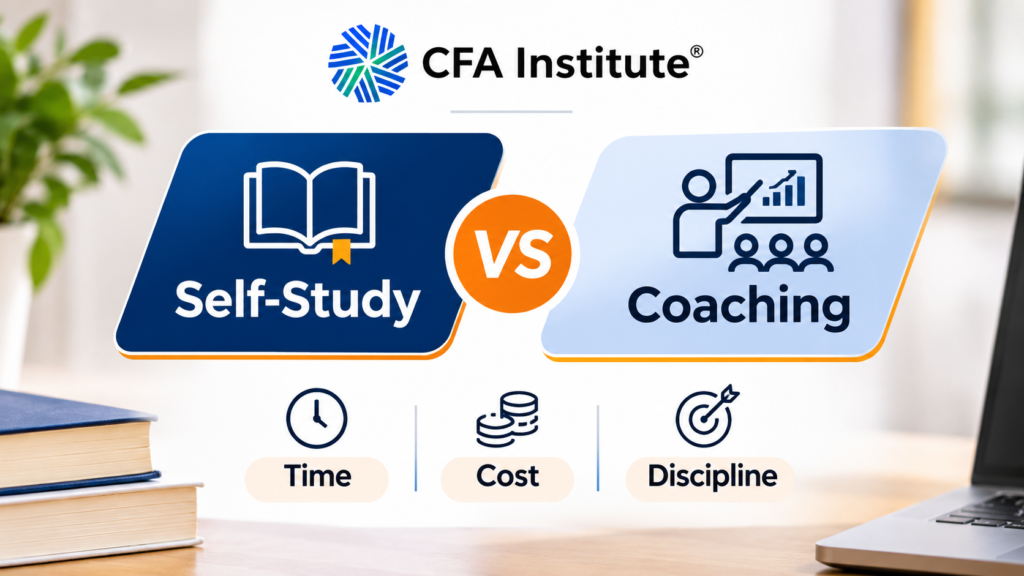
CFA Level 1 Self-Study vs Coaching: Is There a Middle Ground?
Don’t pick extremes. Before you register, try the Level I sample questions that CFA Institute links from its exam page, and see which topics feel comfortable and which don’t. The Learning Ecosystem opens only after you register, so you can’t test it in advance. Once you are registered, spend a few weeks on the platform and its practice questions.
If you score well and your routine holds, carry on alone and consider the Practice Pack for extra mocks. If you stall on one or two topics, pay for targeted help on those topics only. If you can’t keep a routine at all, that is when a full class is worth the money.
CFA Level 1 Self-Study vs Coaching: How to Decide
Ask yourself three questions. Can I find 12 hours every week for six months? Am I comfortable with the quantitative and accounting topics in the syllabus? Will I review every mistake, not just count my score? Three yeses point to self-study. Two noes point to coaching, or at least to a delay in registering.
FAQs
It gives you the curriculum, practice questions, mock exams and study tools, and CFA Institute says successful candidates report over 300 hours per level. Whether it’s enough depends on your background and discipline. Nobody can guarantee a result.
CFA Institute reports that successful candidates spend over 300 hours on average per level, so plan for at least that.
There are 180 multiple-choice questions in two 135-minute sessions of 90 each. Each question has three choices; all questions are weighted equally and there is no penalty for wrong answers.
It is an optional paid add-on. For Level I it includes five extra mock exams, one Prometric mock exam that simulates exam day, 1,000 additional practice questions and curriculum PDFs.
Not necessarily. You can sit the exam at most twice in a calendar year, and not in consecutive windows or in windows within six months of each other.