

Table of Contents
Key Takeaways
- Self-study can be enough: When comparing US CMA self-study vs coaching, remember that you don’t need a coaching class to clear the US CMA. You do need decent accounting basics, good study material and the habit of sticking to a plan.
- Coaching offers structured support: It helps most if tough concepts keep beating you, you need doubts cleared quickly, or you can’t stay consistent on your own.
- You don’t have to choose only one: A bit of both works too. Self-study plus recorded lectures, a question bank and a few mocks can replace full coaching for a lot of people, at a lower price.
- Pay for what you actually need: Good study material, plenty of question practice and realistic mock tests matter. A pricey coaching package isn’t automatically a better one.
- Your learning style matters: What suits you depends on your accounting background, your free time, your budget and how well you study alone.
Introduction
The US CMA is hard work, no way around it. You have to learn the concepts, grind through questions and then use all of it on business cases. And before the first chapter, almost everyone asks the same thing: do I study alone or sign up for coaching?
Both options can work. Some people pass by studying alone. Others only get going once a class is fixed in their calendar and a teacher is there to ask.
Coaching costs money, and plenty of people don’t need all of it. Then again, going solo only to save fees can backfire if you lose motivation fast or hit a wall on tough topics.
So, what should you choose?
It depends on your accounting background, your study habits, your free time and the kind of help you need. Let’s go through both options in practical terms.
Can You Clear the US CMA Through Self-Study?
Yes, it’s doable, as long as you treat it like a job and not a hobby. Nobody forces you to attend live classes or pay for a costly programme just to learn the syllabus and prepare for the exam.
A typical self-study set-up is simple: study material, recorded lectures, a question bank, some mocks and your own revision notes. That’s enough to cover the syllabus. No daily class needed.
Going solo doesn’t mean going blind, though. You’ll want a plan and resources you can trust. A plan on paper beats good intentions in your head every time.
Self-study may suit you if:
- You know the basics of accounting, finance or business subjects.
- You can stick to a timetable without anyone reminding you.
- You’re happy learning from textbooks, recorded lectures and online resources.
- You can spot the topics that trouble you and give them extra time.
- You’ll solve questions regularly instead of only reading the study material.
A B. Com graduate, for instance, has already done financial accounting, cost accounting and basic financial management. Starting alone is easier for them because half the ground is familiar. Their time goes into how the CMA uses those ideas.
A working professional may like self-study too. You can study early in the morning, after office hours or on weekends. Early mornings sound great on paper, but they only work if you actually get out of bed. Pick a time you can keep for months, not one that looks good in a planner.
There’s one catch, though. You have to stay consistent.
Buying material and watching a few lectures won’t get you through. You have to finish topics, solve questions, go over your mistakes and revise. Otherwise even excellent material does very little.
When Does Coaching Make More Sense?
Coaching makes sense when material alone isn’t getting you there.
A good programme lays out the order of topics, breaks down hard concepts, answers your doubts and teaches you how to attack exam questions. If you’re new to accounting, or it’s been years since you studied, that matters a lot.
Coaching may be a better option if:
- You can’t make sense of financial or management accounting without someone explaining it.
- You need a fixed timetable to stay on track.
- You keep pushing your study sessions to tomorrow.
- You’d rather listen to someone explain than learn everything from books.
- You want to know exactly why your answer was wrong, and what to do differently next time.
- You want structured mock tests with feedback on your preparation.
Maybe budgeting theory makes sense to you, but flexible budgets and variance calculations keep going wrong. A fourth read of the same chapter won’t help. Someone solving a few examples in front of you might.
Coaching also gives you accountability. When classes, assignments and test dates are fixed, a routine is easier to keep. Some people need that push, and there’s nothing wrong with admitting it. A fixed class at 7 pm can do what a promise to yourself at 7 pm never does.
Joining a class doesn’t mean you’ll pass, though. You still study outside it, solve questions and revise on your own.
A teacher can explain a concept, sure. Using it in the exam hall is on you.
Visit Unique Global Education for CMA US Classes Inquiry
US CMA Self-Study vs Coaching: A Practical Comparison
Here’s how the two compare. Keep your own situation in mind while you read.
| Factor | Self-study | Coaching |
| Cost | Generally lower | Usually higher |
| Flexibility | Study at your own pace | Depends on class schedule |
| Learning support | You find explanations and resources yourself | Teachers provide explanations and guidance |
| Doubt-solving | Requires independent research or paid support | Often available through faculty |
| Study discipline | Requires strong self-management | Timetables and assignments provide structure |
| Revision | You plan it yourself | Some programmes provide revision schedules |
| Mock tests | You select and attempt them | May be included in the programme |
| Personal attention | Depends on your own approach | Depends on batch size and faculty availability |
Honestly, the material is rarely what separates the two. What differs is how much guidance and accountability you get.
Someone disciplined with good resources may never need a class. Someone else can have the identical resources and still stall without a teacher.
So don’t choose just because it’s cheaper, or because everyone else did. Your situation isn’t theirs.
US CMA Self-Study vs Coaching: What Do You Need to Pay For?
Ask yourself this before spending anything on CMA preparation.
A coaching package is a mixed bag. A few parts are really useful. The rest mostly raise the price.
Check what’s actually inside a package before you pay for it.
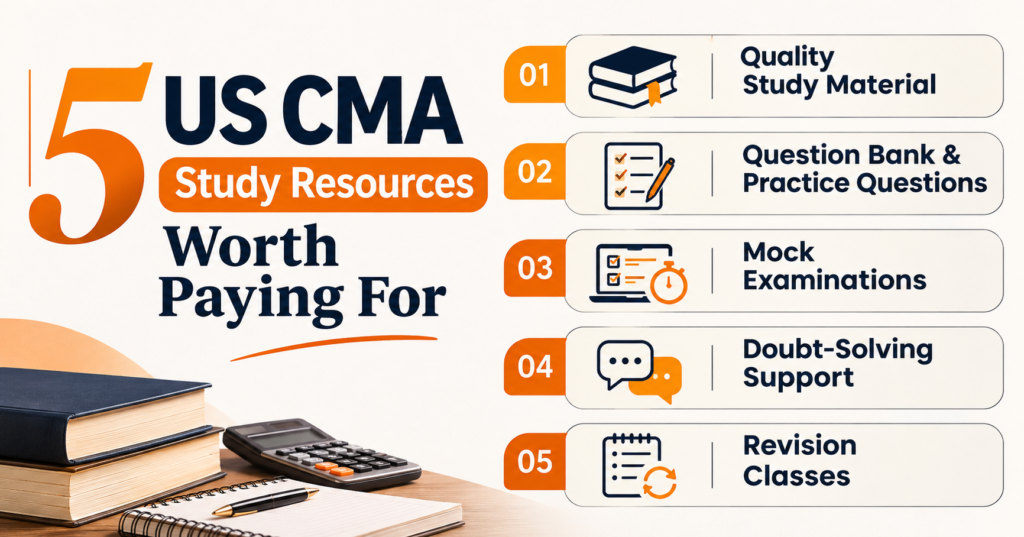
1. Quality study material
You need this whichever way you go. Look for material that covers the current CMA syllabus, explains things clearly and has plenty of practice questions.
Hundreds of hours of video shouldn’t sway you. Relevant, well-made content beats a big number of hours.
2. Question bank and practice questions
Most of your study time should go into solving questions, not reading.
You can read a chapter and feel fine about it. Then a question comes along and you freeze. That’s the gap practice fills.
A decent question bank covers every topic and quickly shows you your weak spots.
3. Mock examinations
Pay for mocks only if they feel like the real thing.
You find out how long each type of question really takes, whether you slip up with the clock running, and which chapters need another round.
Finishing the syllabus doesn’t mean you’re exam-ready. Your scores in timed tests tell you far more. Take a few of them in one sitting, with the clock running and your phone away. That’s how the real exam will feel.
4. Doubt-solving support
This is where coaching earns its money.
If you’re studying alone and the same few topics keep stopping you, book doubt sessions for those. Buying a whole package for three chapters is overkill.
A teacher for every chapter is a waste if you follow most of the syllabus on your own.
5. Revision classes
Revision classes pay off near the exam, once the syllabus is done and you’re trying to see how the topics fit together.
Revision classes can’t stand in for studying. Go in having already covered the topics.
The Hybrid Approach: A Practical Middle Ground
There’s a third route that people often forget: study alone, and pay for help only where you’re stuck.
You don’t have to pick between all alone and all in.
For example, you can:
- Get one good study package with a question bank.
- Plan your own week of study.
- Play recorded lectures only for the chapters that give you trouble.
- Book a doubt session when you’re properly stuck. Don’t wait for weeks.
- Sit full-length mocks before exam day.
- Add a revision programme if you’d like a final push.
You stay in charge of what you spend and still get the things that matter. Keep a simple note of every topic where you lose marks. After two or three weeks, that list shows you exactly where paid help is worth it.
Say financial accounting and cost management feel easy, but corporate finance or risk management don’t. Why pay for lectures on the whole syllabus? Do the easy parts yourself and get help with the hard ones.
It works for busy professionals too. Recorded lectures bend around the workday, and mocks or revision help can be added later if needed.
It won’t suit everyone. If you only move forward when someone is teaching you and checking on you, a proper coaching programme is probably the better spend.
US CMA Self-Study vs Coaching: Which Option Is Right for You?
Think about your education, your work hours and how you actually study. Then see which of these sounds like you.
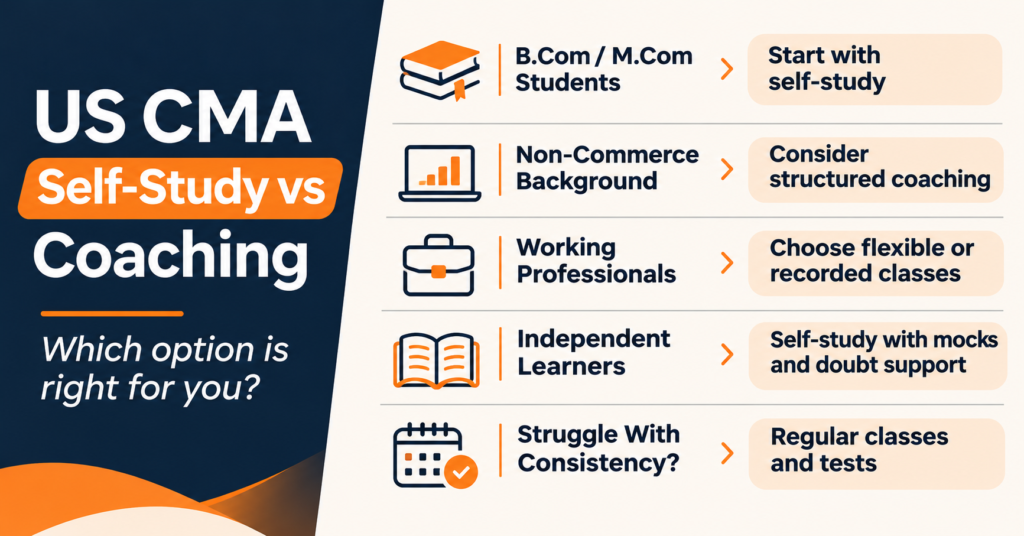
If you are a B. Com or M. Com student
You’ve likely met accounting, costing and financial management before. If studying alone feels fine, begin with a good study package and see how the first few weeks go.
You can add coaching later if certain topics prove hard.
If you are from a non-commerce background
Accounting and finance concepts may be new, so you’ll probably want extra help. Structured coaching makes the first few weeks a lot easier.
Before enrolling, ask whether the programme teaches the basics or just assumes you know them.
US CMA Self-Study vs Coaching for Working Professionals
Your biggest hurdle is probably time, not understanding.
Self-study bends to your day, but you’re the one running the timetable. Can’t make fixed daily classes? Recorded lectures or a flexible programme can still give you the explanations.
Choose a programme around your working hours. A schedule you can’t keep is useless. Be strict about this.
If you are good at studying independently
If you follow the material, solve questions and stick to a routine, a full coaching programme is hard to justify.
Spend instead on a good question bank, some mock tests and a doubt session now and then.
If you struggle with consistency
Be honest with yourself before you pick self-study. If your study plans keep dying in week two, regular classes and tests might be what holds you steady.
How Much Time Should You Give Yourself?
How long it takes varies. Your background, your weekly hours and the way you learn all play a part.
IMA recommends 150 to 170 study hours for each part. Use that as a guide, not a promise. Some people need less, others need far more. Be realistic about your own pace. Plenty of people plan three hours a day and end up with one.
Someone working full-time and studying two hours on weekdays plus a bit more on weekends will follow a very different schedule from a full-time student.
Rushing through the syllabus backfires. Finish each topic properly and keep time at the end for revision, questions and mocks. Gaps you skip now show up again in the mocks.
Final Verdict: US CMA Self-Study vs Coaching
There’s no one right answer here.
Good accounting background, decent time management and a liking for studying alone? Self-study is a sensible, low-cost choice.
Need regular explanations, fixed classes, doubt support and someone holding you accountable? Coaching can be worth the extra money.
Somewhere in the middle? Then look hard at the hybrid route.
At the end, nobody passes because their fees were high. People pass because they understood the concepts, solved lots of questions and kept at it week after week.
Before you sign up anywhere, work out what you actually need help with. Maybe it’s a full course. Maybe it’s just good material, a question bank and a few mocks. Take a day or two to think it through before you pay anyone.
Pay for what helps. Skip what just happens to be in the bundle.
Frequently Asked Questions
Yes. IMA doesn’t make coaching compulsory. Plenty of candidates prepare alone with good study material, a question bank, mock tests and a steady plan. Coaching is a choice, not a rule.
It can be, if you can fit your study around your job. Recorded lectures help when you need an explanation but can’t attend a live class. Even one steady hour on workdays adds up over a few months.
Not always. But if accounting is new to you, a teacher can make your first pass through financial and management accounting much easier.
It can be. If you follow most topics yourself and only need help with a few subjects, doubts or mocks, hybrid is often the smarter spend.
Ask yourself a few things. Is the syllabus finished and the main topics revised? Do timed mocks go well on accuracy and time? Do unfamiliar questions still throw you? If it looks good, you’re close.
Not necessarily. Judge each part separately. You might manage one part alone and want guidance for the other, and that’s perfectly fine.