

Table of Contents
Key takeaways
- Even if you are weak in maths, you can pass CFA Level 1. You do need a few basic skills in place before you start.
- Level I has 180 multiple choice questions, and many of them need a formula and a calculator.
- Quantitative Methods is growing in 2027. The CFA Institute topic outline lists it at 11 to 14% of the exam, up from 6 to 9% in 2026.
- Spend two to four weeks on the checklist below, then begin the curriculum.
Many CFA candidates say the same thing. The finance ideas make sense, but the numbers slow them down. If you are weak in maths or left maths behind after school, that worry is fair. The good news is that you can fix it before you open the first reading. This guide covers what to refresh, what is changing in 2027, and how to practice.
Weak in Maths? How Much Maths Does CFA Level 1 Really Need?
The CFA Institute describes Level I as a test of key terms, concepts and formulas. The exam has 180 multiple choice questions in two sessions of 135 minutes. Each session has 90 questions, which gives you about 90 seconds per question. Every question has three answer choices, A, B or C.
Some questions only check a concept. Others ask you to calculate a return, a bond value or a ratio. For most of them the maths is basic. You will mostly apply formulas, not prove them.
The real challenge is speed. With 90 seconds a question, you cannot stop to relearn how percentages work. That is why a short foundation phase pays off.
Visit Unique Global Education for CFA Classes
What is changing in 2027?
The 2027 curriculum applies to candidates sitting exams from February 2027. The CFA Institute says the main updates sit in Quantitative Methods and Equity Investments. Together they make up about 25% of Level I.
In Quantitative Methods, coverage of estimation, simulation and portfolio optimization expands. A new module introduces financial data science, AI and large language models. The curriculum also adds Equation Explorers. These are interactive tools for ideas like time value of money, implied return and cash flow relationships.
The Level I exam page lists Quantitative Methods at 11 to 14% for 2027. For 2026 it was 6 to 9%. Weights can change, so always check the official topic outline for your exam window.
Weak in Maths? Your CFA Level 1 Foundation Checklist
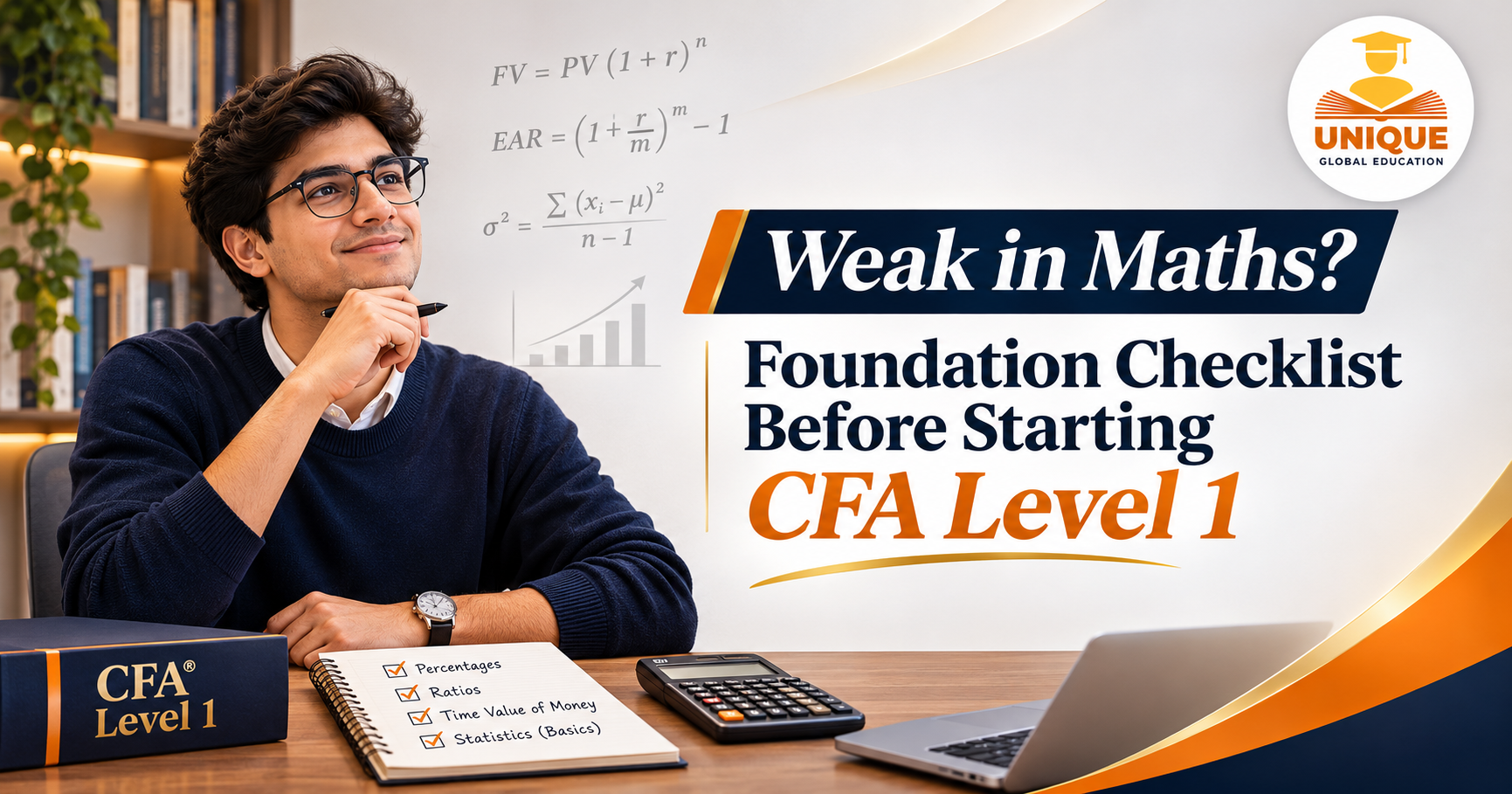
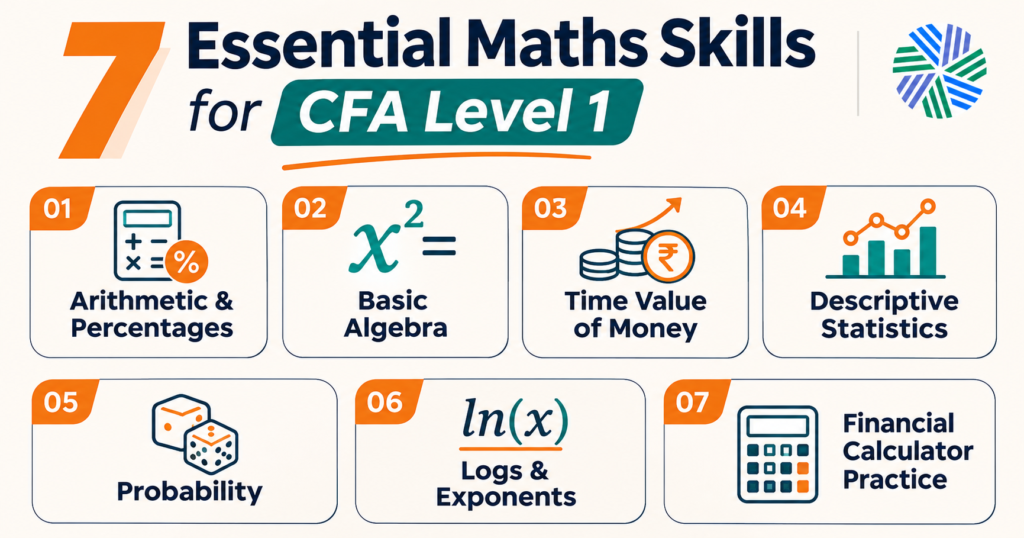
Work through these in order. Each one connects to something you will meet in the curriculum.
1. Arithmetic and percentages.
Be comfortable with fractions, decimals and the order of operations. Know that 5% is 0.05. Returns, yields and ratios are all percentages, so you will use this in almost every topic.
2. Basic algebra.
Practise rearranging a formula to find the unknown. Learn powers and roots too. For example, if 100 grows to 121 in two years, the yearly growth rate is the square root of 1.21, minus 1. That is 10%.
3. Time value of money.
This is the most important skill on the list. Learn future value, present value, discounting and annuities. Bond valuation, equity valuation and many corporate finance ideas rest on it. The new Equation Explorers target this exact area.
4. Descriptive statistics.
Know the mean, median, mode, range, variance and standard deviation. The Quantitative Methods topic covers central tendency, location and dispersion. Risk is often measured with these tools.
5. Probability.
Learn the basic rules and how to find an expected value. Get a feel for the normal distribution and z-scores. The curriculum uses probability to measure risk in investment decisions.
6. Logs and exponents.
You do not need advanced maths here. A simple understanding of natural logs and the number e helps with continuously compounded returns.
7. Your calculator.
At Level I you can use only the Texas Instruments BA II Plus or the Hewlett Packard 12C. The CFA Institute advises you to learn the features you need for the curriculum formulas, because it saves time on exam day. Practise the time value of money keys, memory storage and the statistics worksheet.
How Should You Practise If You Are Weak in Maths?
Keep it small and steady. Give 20 to 30 minutes a day for two to four weeks. Pick one skill, do ten problems, check your answers and fix the mistakes. Then move to the next one.
Do not wait until you feel perfect. Once you register, the Learning Ecosystem gives you the digital curriculum, practice questions and mock exams. Use it early. Successful candidates report spending over 300 hours on average on each level, so a few weeks of foundation work is a small cost.
Also, learn from your errors. If you keep missing questions on percentages, go back to that skill. Weak spots are easier to fix in week one than in week twelve.
Concluding thoughts
Being weak in maths is not a reason to avoid the CFA Program. It is a reason to prepare in the right order. Fix the basics first, learn your calculator, and then start the curriculum with a calmer mind. The 2027 changes put more weight on numbers, so the early effort will help you more than ever.
FAQs
Not really. I see people overthink this one all the time. Level I is mostly about knowing terms, concepts and formulas, and the calculations are usually plain percentages, averages and time value of money. What hurts weak candidates is speed, not difficulty. You get about 90 seconds a question, so shaky basics eat your time fast. Keep in mind that the 10-year average pass rate for Level I is 41%, which tells you the exam punishes candidates who walk in unprepared, maths or no maths.
Only two are allowed at Level I: the Texas Instruments BA II Plus or the Hewlett Packard 12C. Most people pick the BA II Plus. Whichever you choose, buy it early and use it every day while you study, because fumbling with the keys on exam day costs you minutes you don’t have. And don’t forget your passport. They check it at the test centre.
No. All questions carry equal weight and wrong answers are not penalised. Answer every question, even if you have to guess.
Successful candidates report over 300 hours on average per level. If maths is a weak area, add two to four weeks of foundation work before you begin.
Quantitative Methods gets more weight and new modules, including one on financial data science. The exam still focuses on concepts and formulas. If you sit from February 2027, use study material built for the 2027 curriculum.