

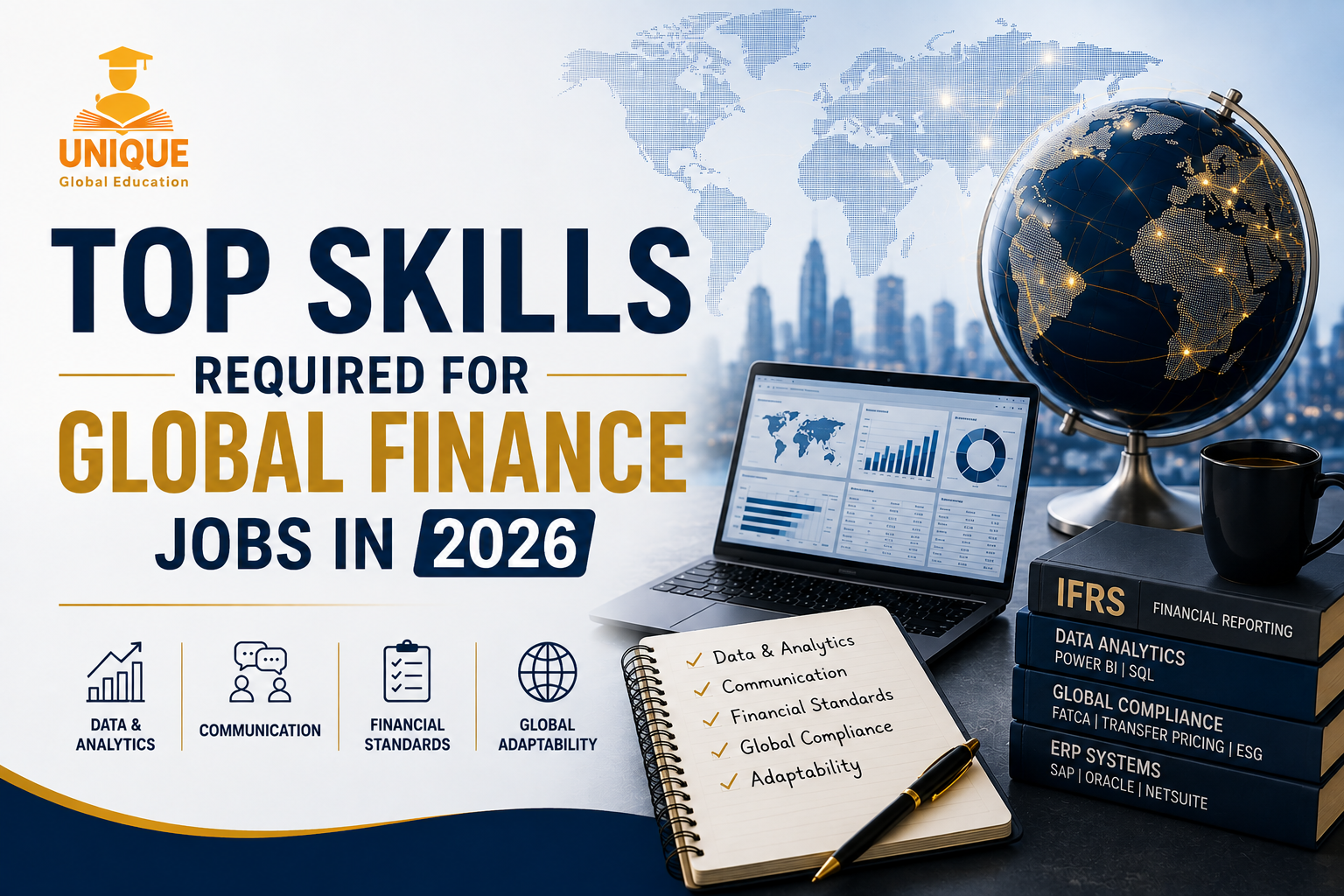
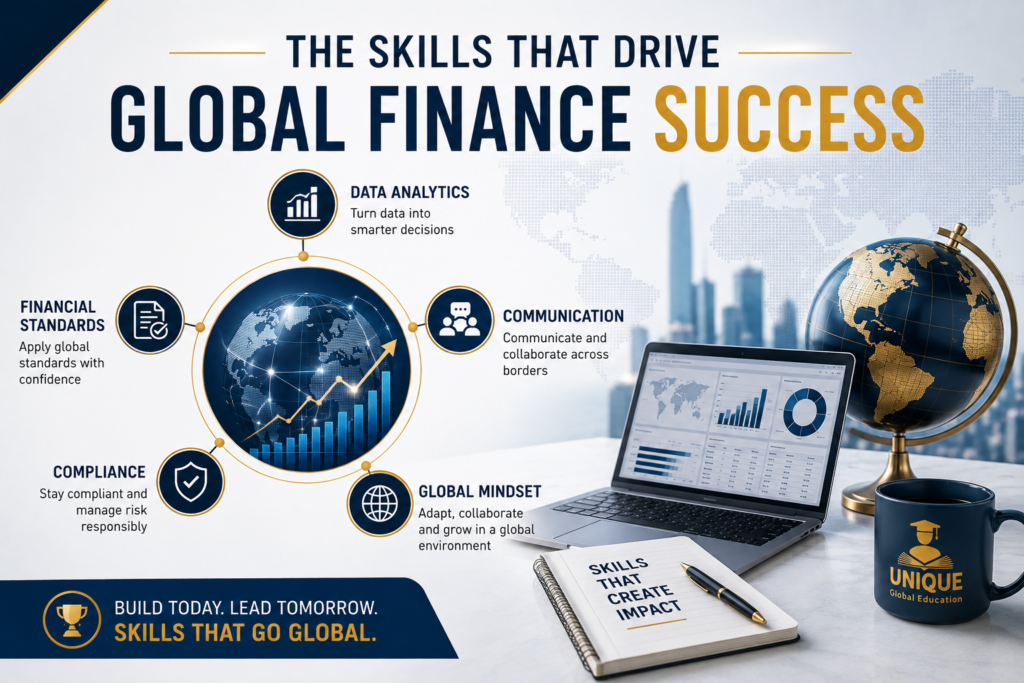
Quick answer: If you asked me to sum up everything, I’ve learned watching people move into global finance jobs, it would come down to this. The technical stuff, Power BI, basic SQL, knowing your way around a dashboard, gets you noticed. Cross-cultural communication and comfort with ambiguity are what actually decide whether you last.
IFRS versus GAAP, FATCA, transfer pricing, ERP adaptability, all of it matters, but I’ve seen technically brilliant people struggle in these roles for reasons that had nothing to do with their technical skills. The part almost nobody prepares for is how differently global teams actually work day to day, and that’s usually the thing that trips people up first.
Table of Contents
What is the most important skill for a global finance jobs?
Data and analytics fluency is currently the single most filtered-for skill in global finance hiring, and it’s grown more important over the last couple of years, not less. When teams span multiple countries, most collaboration happens through shared dashboards and asynchronous reports rather than face to face conversation, simply because time zones make constant live discussion impractical.
Power BI, advanced Excel functions like Power Query and pivot modeling, and increasingly basic SQL to pull data directly from larger systems have become baseline expectations rather than differentiators. I’ve noticed recruiters for global finance roles asking pointed questions about dashboard experience even for positions that aren’t formally analytics focused, simply because so much day to day reporting now runs through these tools by default.
If your Excel skills stop at basic formulas and pivot tables, that’s usually the first gap worth closing before applying to these roles.
For More Finance Related Question visit uniqueglobaleducation.com
Why does communication style matter in global finance jobs?
Communication style matters because stakeholder expectations vary sharply by region, and getting this wrong shows up repeatedly in performance reviews even when the technical work itself is solid. A US based stakeholder usually expects direct, concise updates with the bottom line stated early.
A Japanese or German counterpart often expects more formality, different norms around hierarchy, and a different pace around how directly feedback gets delivered. Someone used to working with a single domestic team often assumes their natural communication style will translate everywhere, and that assumption tends to break down fast once they’re managing stakeholders across three or four different countries.
This is rarely taught explicitly in college or even in early corporate training, which is exactly why it becomes a recurring feedback point for people new to global roles, usually phrased vaguely as stakeholder management rather than named directly as a cultural communication gap.
Do I need to know IFRS or just my local accounting standard?
You need working depth in IFRS, not just surface familiarity with your local framework. Cross-border reporting roles regularly require understanding how IFRS differs from US GAAP in practical, applied terms rather than just definitional ones.
This includes revenue recognition timing, lease accounting treatment, how financial instruments get classified differently under each framework, and how consolidation rules shift when subsidiaries operate under different standards.
Students who only study IFRS briefly before an exam and never revisit it tend to struggle once they’re actually working with entities reporting under multiple frameworks simultaneously. Knowing only your home country’s standard becomes a visible gap quickly in a multinational reporting role, often within the first few weeks of actually touching cross-border numbers.
What compliance frameworks should finance professionals know for global roles?
The frameworks that come up most often are FATCA, basic transfer pricing principles, cross-border tax implications, and ESG reporting requirements, which are becoming mandatory across a growing number of markets each year. You don’t need specialist level expertise in every single one of these areas.
What actually helps is having enough working knowledge to understand why a compliance team is flagging something in the first place, rather than dismissing it as someone else’s problem entirely.
This working knowledge also tends to make finance professionals more useful in cross-functional conversations, since compliance issues in global companies rarely stay contained to just the compliance team.
How important is ERP system knowledge for global finance careers?
ERP system knowledge itself matters less than how quickly someone adapts to a new system when they’re dropped into one. Global finance teams frequently work across SAP, Oracle, and NetSuite, sometimes because of mergers, and sometimes simply because different regional offices historically adopted different platforms before any centralized decision was made.
Hiring managers consistently value candidates who’ve demonstrated they can learn a new system fast in a previous role, even if it’s a completely different platform than what the new company actually uses. That kind of adaptability signals something more useful than platform specific expertise, because platforms change but the ability to ramp up quickly doesn’t.
Why do global finance managers value comfort with ambiguity?
Global roles involve far more unstructured problem solving than domestic roles typically do, because processes that work cleanly for one country’s finance team often don’t translate well to another due to local regulation, tax treatment, or simply different cultural work habits.
Someone coming from a domestic role with predictable, well documented processes can find this genuinely disorienting at first. Managers specifically look for candidates who can work through that mess without expecting everything to be clearly defined upfront, and this expectation almost never appears explicitly in a job posting.
It tends to surface later, usually during the interview process itself, through questions about how a candidate handled unclear or changing requirements in a past role.
What should students do right now to prepare for global finance jobs?
Students preparing for global finance roles should go beyond stacking certifications and instead build direct, practical exposure to cross-border scenarios wherever possible.
This means studying IFRS versus GAAP comparisons properly rather than skimming through them once before an exam, becoming genuinely comfortable with at least one data visualization tool beyond basic Excel, and taking seriously any opportunity to work on a project involving a team outside their own country, even a small one.
These small pieces of exposure tend to matter more in interviews than an extra certification, because they show a candidate has actually encountered the friction that comes with global work rather than just studying it in theory.
Frequently Asked Questions
No. English remains the standard working language across most global finance teams. Understanding communication style differences matters far more than literal language fluency.
Power BI covers a lot of ground on its own, but basic SQL is increasingly expected because it lets you pull data directly instead of depending on someone else to prepare it first.
Use official IFRS versus GAAP comparison resources directly, or look for internships at firms that handle multinational clients, since that’s where this knowledge actually gets applied rather than just studied.
Generally, yes, though the gap varies by company size, location, and specific role. The more consistent difference tends to show up in career trajectory and exposure rather than just starting salary.
No. Data tools, compliance awareness, and cross-cultural communication skills are typically built steadily on the job or through targeted self-study over time. Very few candidates arrive with all of this already in place from college alone.